
Commander Shepard’s Actor Accidentally Immortalized One Mass Effect Race as Steve Buscemi
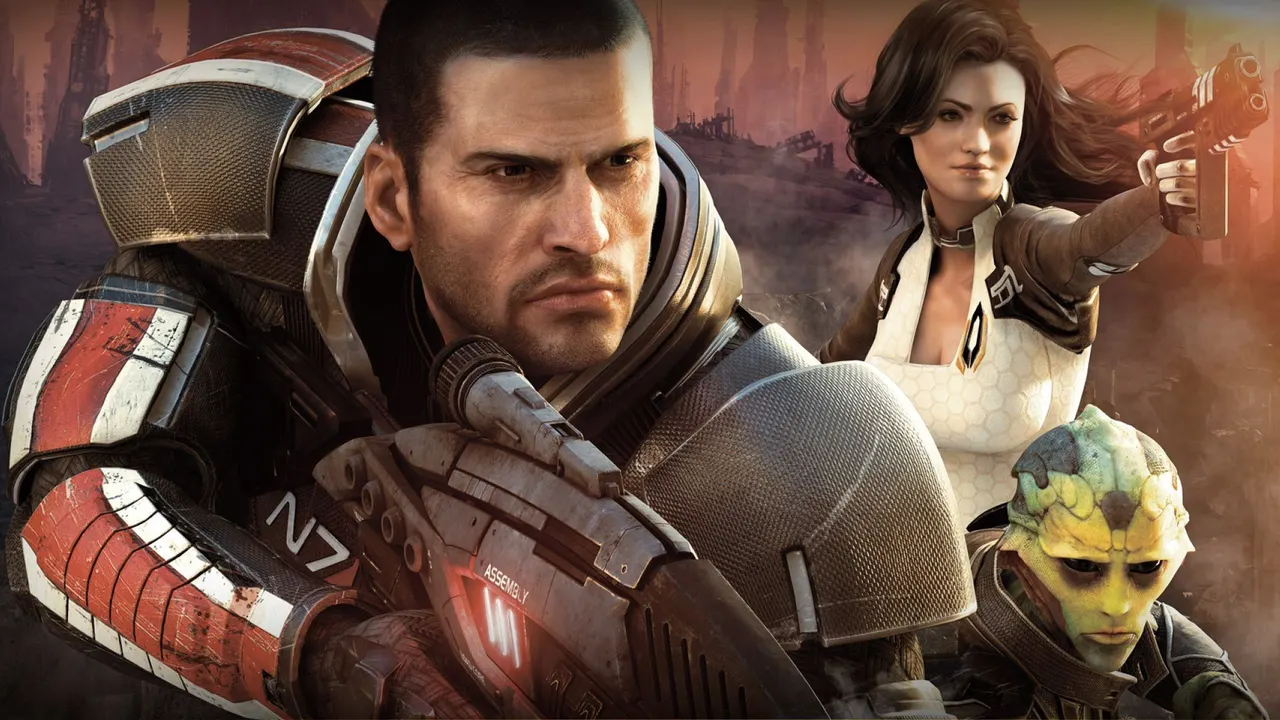
Polygon spoke to Mass Effect's Mark Meer about how he joined the series and how he and fellow Shepard Jennifer Hale defined the character.
Mark Meer never planned on saving the universe, but the universe had other plans.
You know Meer from a lengthy association with BioWare’s most popular RPGs. He’s lent his voice to several of the studio’s games, from Neverwinter Nights to Jade Empire. Most famously, he voiced the male version of Mass Effect’s Commander Shepard, but his work with BioWare dates back to one of the studio’s earliest breakout hits.
“I did one line in Baldur's Gate 2, and then subsequently, BioWare just kept hiring me for every subsequent project leading up to the Mass Effect trilogy,” Meer said.
In the wake of EA shutting down BioWare, laying off its remaining staff, and canceling Mass Effect: Universe, Polygon spoke with Jennifer Hale and Meer, the voices of Mass Effect’s Commander Shepard. They talked about their hopes for the future of Mass Effect, but also looked backward. Both actors recorded for the studio’s Baldur’s Gate games. Meer would play “monsters and antagonists and that sort of thing.”
They also both had roles in BioWare’s Star Wars: Knights of the Old Republic. Hale notably played Bastila Shan, while Meer voiced Carth Onasi, but only in KOTOR’s demo. The role in the full game eventually went to Raphael Sbarge, who, as it happens, ended up playing Kaidan Alenko in Mass Effect. (“Because he replaced me, that's why I killed Kaiden on Virmire,” Meer likes to joke.)
While Mass Effect was still in its concept art stage, he was brought in to aid in a presentation for the developers about how the aliens they were creating might sound. “I don't know if people realize how instrumental Mark was in defining the sound of every single species in this game,” Hale said, shouting out her friend and fellow Shepard.
“So what does a typical salarian sound like? What does a typical krogan sound like? That kind of thing,” Meer said. “It was nice to see some of the advice that I gave or some of the suggestions I made get implemented.
“I do take credit for the salarians all having the cadence of Steve Buscemi,” Meer added with a laugh. The first salarian he did was essentially a Buscemi impression for a demo, and it stuck.
While recording all those aliens, BioWare asked Meer if he’d audition for Shepard. “I thought there was absolutely no way I would get it,” Meer said, “which is probably good because I was not nervous at all.” He thought it would be “impossible” for him to land the role, and after auditioning he could “go back to doing my alien stuff.”
Of course, that wasn’t the case. He still did record “a bunch of aliens” for Mass Effect, like the vorcha, but that work was secondary to his role as Shepard. He was thrilled, but also somewhat shocked — and that shock doubled when he learned he’d be doing the same role as Hale, a titan of the industry. “It was sort of like being told, ‘You've been cast in this movie in the lead, and Meryl Streep will be playing opposite you playing the same character.’”
“Getting to be the lead in one of these was really a dream come true.”
Hale noted that Meer “set the tone” for Shepard by recording the initial couple sessions first. He was in Edmonton with BioWare while Hale recorded her lines in Los Angeles. In the early going, Hale’s LA team would play for her whatever Meer had recorded before she’d tackle her lines. His performance would influence the direction Hale took. She’d record a line multiple ways, including imitating Meer’s performance and then giving her own spin on a line read.
Eventually they got into a groove and, because of the way schedules work out, Meer wouldn’t always record first. Regardless of who was up, however, BioWare did have a specific request: “The one thing that they did really stress was you have to take the exact same amount of time to say the line,” Meer said with a laugh.
While Hale isn’t a gamer herself (“I suck at it,” she joked), Meer is a big fan of choice-based RPGs. “Getting to be the lead in one of these was really a dream come true,” he said.
The player is given a lot of flexibility in customizing Shepard, and Mass Effect’s Paragon and Renegade morality system allows them even more freedom in creating the hero. “So we really had to find the core of Shepard. What is the same between Renegade and Paragon?” Meer said.
He compared a Paragon Shepard to an upstanding Paladin in Dungeons & Dragons, and a Renegade Shepard to a “sociopath [who’s] still saving the galaxy, but not being polite or empathetic about it in any way whatsoever.” No matter what, Meer, Hale, and their directors settled on Shepard being a “military officer that's used to giving commands under pressure and is very professional in that sense,” Meer said.
Both Paragon and Renegade are worth playing, and both have their moments to shine. However, the freedom of a Renegade Shepard strikes a certain cord with both actors. “I always joke that Paragon's who I wish I was and Renegade's what I wish I could say,” Hale said. “I think we all aspire to be Paragon, but sometimes wish we could be Renegade,” Meer added.
Because of the Paragon and Renegade system — and because these games are just so damn good — the community loves jumping back into Mass Effect for a new playthrough, regardless of if they make new choices or roll with the same ones as always.
“You know, next year will be the 20th anniversary of the first Mass Effect game,” Meer said. “The fact that we are still talking about it, that we still have fans that are so passionate about that universe — it is impressive and humbling.”