
Software squeezes more data out of Webb Telescope for imaging exoplanets
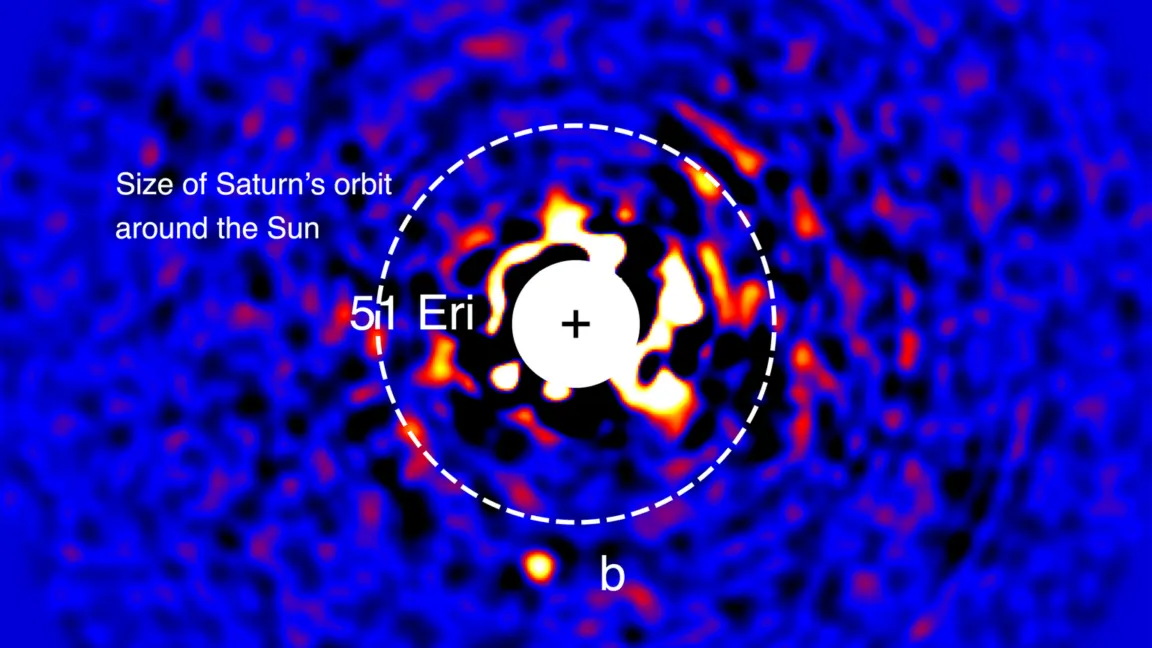
With a huge and still-growing catalog of exoplanets, researchers are anxious to take the next steps: trying to infer what conditions are like on them, either by imaging them directly or by capturing the light that has passed through their atmosphere. Both are substantial challenges, given the presence of stars that are far, far brighter than light that has come to us via the planet. While telescopes can be fitted…
With a huge and still-growing catalog of exoplanets, researchers are eager to take the next steps: trying to infer what conditions are like on them, either by imaging them directly or by capturing the light that has passed through their atmosphere. Both are substantial challenges, given the presence of stars that are far, far brighter than light that has come to us via the planet.
While telescopes can be fitted with devices called coronagraphs that block out much of a star’s light, there are limits to their effectiveness, caused by noise from subtle variations in the telescope’s configuration and pointing between observations. Now, researchers have developed a new software package that optimizes a physical model of the telescope in a way that allows us to better model these differences, producing low-noise imaging of exoplanets.
Point spreads
Central to this work is the concept of a point spread function. If you use a telescope to image a single point of light, it will not appear that way in the actual image. Instead, it will be slightly blurry and spread out, due to imperfections in the telescope hardware and the limits of our ability to keep it pointed accurately through the time it takes to image something. The mathematical description of how a telescope distorts a point of light is called its point spread function.
There are two ways to figure out what the point spread function is. One is to use the telescope to image a known target and use those observations to derive a mathematical description of the point spread function. This is effective at reducing noise but has its limits, as the behavior of the telescope hardware can change over time, and the point spread function may vary with the wavelengths being imaged.
The alternative is to try to model the hardware’s behavior and use that model to derive a point spread function. But modern telescopes are incredibly complicated instruments, with many, many factors feeding into their performance in ways that can be difficult to ascertain, even with the full engineering schematics. As a result, these models simply contain too many parameters that need to be tuned to make this route computationally tractable.