
Magic’s Star Trek Set Doubles as a Must-Watch Guide to the Sci-Fi Franchise
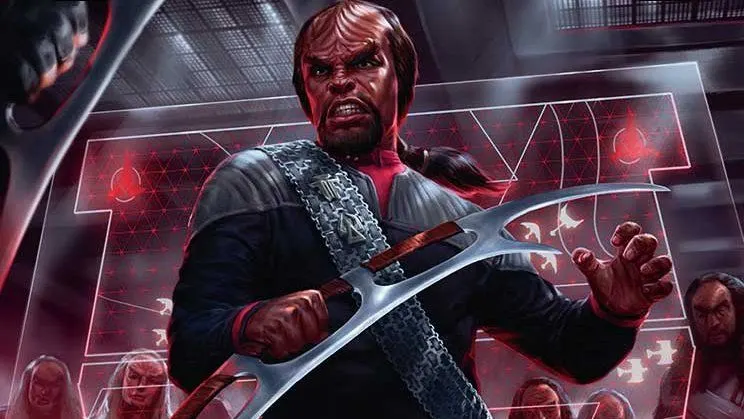
Prerelease events for Magic ’s Star Trek begin this weekend before a global launch on Nov. 13. The set celebrates six decades of the franchise with cards featuring familiar characters, starships, and memorable adventures. Among them are 14 saga enchantments inspired by — and named after — 13 television episodes and one movie.
Star Trek has spent 60 years introducing audiences to strange new worlds, unforgettable characters, and enough temporal anomalies to make even the most dedicated Starfleet officer question what day it is. Now those adventures are finding a new home in Magic: The Gathering.
Prerelease events for Magic’s Star Trek begin this weekend before a global launch on Nov. 13. The set celebrates six decades of the franchise with cards featuring familiar characters, starships, and memorable adventures. Among them are 14 saga enchantments inspired by — and named after — 13 television episodes and one movie.
Sagas always tell stories through a series of chapters, with different effects triggering at the start of each round. Generally speaking, they’re used to represent major events within Magic lore, but in previous Universes Beyond crossover sets, we’ve also seen them represent Marvel Comics story arcs or even legends associated with past Avatars from Avatar: The Last Airbender. The Star Trek set uses sagas to focus on specific Trek stories. It’s a fitting concept for a long-running TV show where seemingly routine missions frequently go spectacularly wrong.
Here's a look at the 14 stories that inspired each of these sagas.
14 "The Naked Time" (Star Trek: The Original Series, 1966)
A mysterious infection spreads through the Enterprise, causing officers to lose their inhibitions. Sulu (George Takei) becomes a sword-wielding swashbuckler, while Spock (Leonard Nimoy) struggles to control his emotions. The episode offers an early glimpse beneath Spock's logical exterior while demonstrating that even Starfleet's finest occasionally make fools of themselves.
13 "Balance of Terror" (Star Trek: The Original Series, 1966)
When a Romulan warbird attacks Federation outposts, Kirk (William Shatner) engages its commander (Mark Lenard) in a deadly game of cat and mouse. Inspired by submarine warfare films, this suspenseful episode introduces the Romulans and explores prejudice, duty, and the mutual respect that develops between two enemies who would rather not be fighting.
12 "The City on the Edge of Forever" (Star Trek: The Original Series, 1967)
Kirk and Spock travel to Depression-era New York after McCoy (DeForest Kelley) accidentally alters history. There, Kirk falls in love with Edith Keeler (Joan Collins), whose survival will lead to a future where Nazi Germany wins World War II. Restoring history means allowing her to die, resulting in one of Star Trek's most heartbreaking stories.
11 "Amok Time" (Star Trek: The Original Series, 1967)
Spock's mysterious behavior leads the Enterprise to Vulcan, where his biological need to mate results in a traditional ceremony and a fight to the death with Kirk. The episode introduces pon farr, expands Vulcan culture, and features that unforgettable fight music that's probably playing in your head right now.
10 The Wrath of Khan (Star Trek II: The Wrath of Khan, 1982)
Ricardo Montalban's Khan Noonien Singh returns seeking revenge against Kirk, leading to one of the franchise's greatest confrontations. Beyond the action, the film explores aging, friendship, and sacrifice, culminating in Spock's heartbreaking decision to give his life to save the Enterprise.
9 "The Measure of a Man" (Star Trek: The Next Generation, 1989)
When Starfleet orders Data (Brent Spiner) to undergo a potentially dangerous experiment, a hearing determines whether the android has the right to refuse. Picard's (Patrick Stewart) defense transforms a courtroom drama into a powerful examination of artificial intelligence, individual rights, and what constitutes life. Its questions remain remarkably relevant today.
8 "Sins of the Father" (Star Trek: The Next Generation, 1990)
Worf (Michael Dorn) returns to the Klingon homeworld after his deceased father is accused of treason. He uncovers a political conspiracy but ultimately accepts disgrace to protect the Empire. This defining Worf episode expands Klingon culture while exploring the complicated relationship between family, honor, and duty.
7 "The Best of Both Worlds" (Star Trek: The Next Generation, 1990)
The Borg capture Picard and transform him into Locutus, forcing the Enterprise crew to confront their own captain. One of television's greatest cliffhangers, this two-part story establishes the Borg as terrifying adversaries and leaves lasting consequences for Picard and the entire franchise.
6 "Unification" (Star Trek: The Next Generation, 1991)
Leonard Nimoy returns as Spock, secretly working toward reunification between the Vulcans and Romulans. Picard and Data travel to Romulus to investigate, uncovering a political conspiracy. Beyond the excitement of Spock's return, the story explores reconciliation between civilizations divided by centuries of hostility.
5 "The Inner Light" (Star Trek: The Next Generation, 1992)
A mysterious probe causes Picard to experience an entire lifetime on a dying planet, complete with a wife, children, and community. Although only minutes pass aboard the Enterprise, Picard lives for decades. It's a beautiful examination of memory, identity, and the extraordinary value of an ordinary life.