
Cairn 'Belongs' Next to Death Stranding in ‘History of Grand Adventure Games'
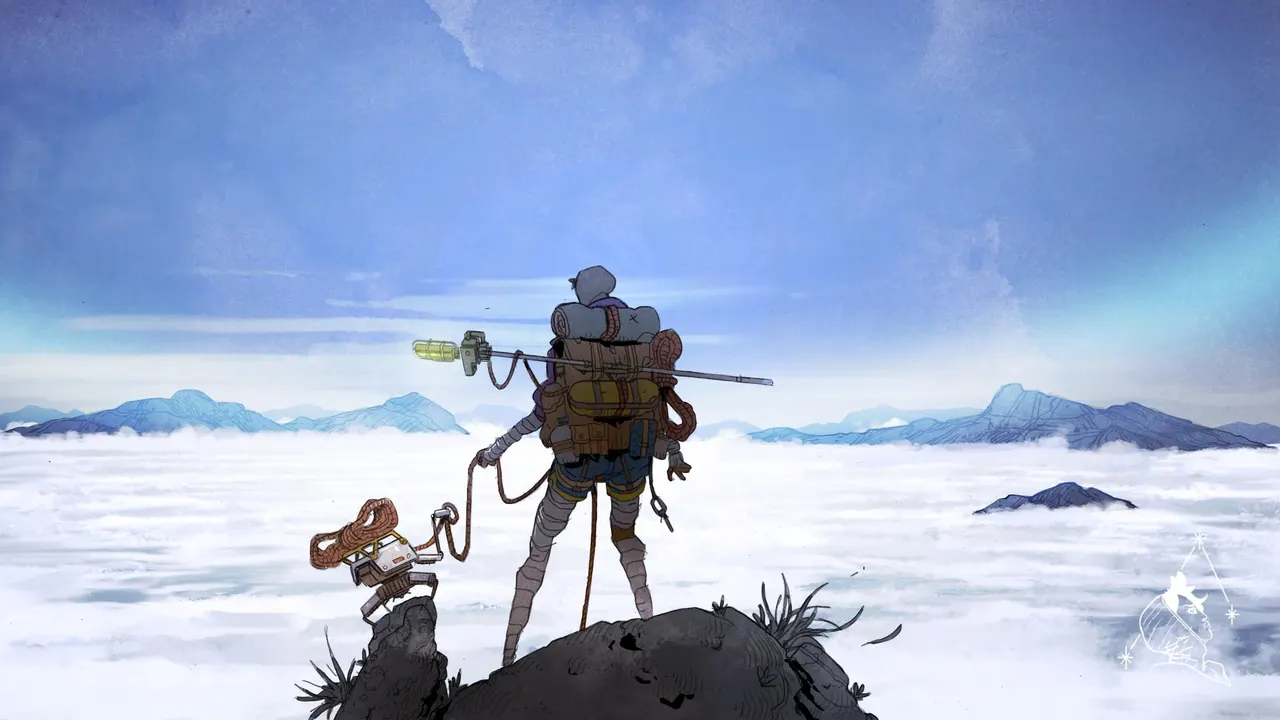
Game Bakers co-founder and Cairn producer Audrey Leprince did not set out to “simulate climbing.” The vision was to build an action-adventure game about survival, obsession, sacrifice, and what drives someone to accomplish the impossible. With Cairn ’s new DLC On the Trail: Deep Water out now, Leprince spoke to Polygon about scaling the project and working with director Emeric Thoa to produce a project more…
It’s easy to box in Cairn, the latest from French studio The Game Bakers. Rendered in Mobius-like illustration and executed with intricate climbing mechanics, the story of a climber named Aava attempting her white whale, the seemingly insurmountable Mount Kami, could look simplistic or sporty at first scroll on Steam. But any player who makes it past the first cliff face, struggles to grip a puzzling rock formation as they reach for salvation, encounters one of the unlikely passersby encountered in respite, or plummets off the mountain only to be saved by a well-placed piton, knows there’s so much more psychology and physicality beating through the veins of Cairn.
Game Bakers co-founder and Cairn producer Audrey Leprince did not set out to “simulate climbing.” The vision was to build an action-adventure game about survival, obsession, sacrifice, and what drives someone to accomplish the impossible. With Cairn’s new DLC On the Trail: Deep Water out now, Leprince spoke to Polygon about scaling the project and working with director Emeric Thoa to produce a project more meaningful than a simple sports game.
[Ed. note: This interview has been edited and condensed for clarity.]
Polygon: What did you set out to do with Cairn? What was the thing you had to accomplish?
Audrey Leprince: With Cairn, it was really straightforward: We were gonna do a game about climbing a mountain. So it was this lonely ascent of an impossible mountain. And that's all. There was nothing else in the game.
It was just the physical experience at the very beginning?
Yeah, with Emeric Thoa, the creative director of the game, he had this intuition that we could make something very strong with a climbing game — and especially with a very gameplay-focused game, coming back from Haven — to a game that would be really gameplay-first. And he had this vision of this very simple climbing controller where you could very naturally, very intuitively give the player a controller, push a stick, click a button, and up you would be climbing a mountain.
And then we prototyped a lot around that. It took us a long time to be sure we had something that was gonna be deep enough and fun enough to make a whole game. The rest came after that, I would say.
There might be a few games with similar mechanics, but I think people often think of Breath of the Wild as a definitive climbing experience. But that's because you're climbing up big mountains, not because of how you're climbing them. Why don't you think we've seen other games like Cairn?
I think it's a conjunction of two things for Cairn. One, it's actually really hard to do a physics-based game like Cairn, where you can actually climb in a realistic way. There's a reason why many climbing games are goofy, right? It's because it's really hard. You have a lot of bugs. So it's better to embrace the physics bugs than try to get something completely realistic. There's a conjunction of, it's really hard to get a system that is at the same time realistic, looking good enough and simple for the player to control. And I think the other reason why a Cairn was one of the only ones to do it is that nobody was crazy enough to do a game just about climbing. I mean we tried to say that to people and they were like, "What? No, you mean there's gonna be boss fights in between or there's gonna be something else happening. It's not gonna be just climbing, right? No, it can't be."
Can you describe how balanced investing in realistic physics and science in this game, then departed from realism on a design level?
To be completely transparent, with Cairn, we never wanted to make a very realistic, accurate climbing game. We wanted to capture the fantasy, the imaginary, around climbing a mountain. And for that we had to build a system that was gonna be realistic enough. For us, that was the way we tried. Never be stopped by realism. Always allow us to have what we want for the experience to be as strong as possible.
So we actually had to build this physics system, and it was really difficult. We hired some engineers in our team that were very strong in math. Stronger kind of profile that we've never had before in the team. That was a big deal. But then we also allowed ourselves to break realism; like we have a climbot, right? Like a robot that's carrying the pitons and belaying you over the mountain? So we just wanted to do whatever it took to serve the experience to make it as fun and immersive as possible, but not push it on the realistic path.
Would you call Cairn an action game?
Yeah, we definitely call it an action-adventure game. At first, it was easy to say Cairn is a climbing game, but we think Cairn really belongs in that history of grand adventure games — you know, like Death Stranding, for instance. It's much more than a climbing game. It happens that you are climbing, but it's also telling you an epic story, it's an adventure, you explore, you discover, you survive in the mountain. Definitely action-adventure.
I'd be curious to know more about how the story came together, because it obviously didn't start from a place of story. But the story is so rich and satisfying and feels like it's building along with that climb. How did you find your way into a story when you just wanted to make a great climbing game in the beginning?
We wanted to capture the experience of what it means to be on the mountain, a high-altitude mountain. So it could not just be climbing on small walls or climbing in a gym, right? It had to capture the whole range of emotions and experiences that you would feel as an alpinist. Necessarily we can't just have the system. We have to bring everything about the work it takes to get at that level to go and climb this kind of summit, the sacrifices it demands, the discipline it demands, the determination it demands, and everything you have to choose between training and doing these dangerous climbs and the people and the life you're leaving at home. So all those tough decisions. We had to have a story that would make you think about those decisions and feel them also as strongly as possible
How do you think game writing and storytelling bring people closer to the mechanics? That seems like it would be a defining feature of this medium.
Well, actually, I think Cairn is a perfect exemplification of a complete match between gameplay and story. It's very rare when the character you are playing is completely aligned in terms of objectives and gameplay with what you are supposed to do in the game. Whether the story is telling you is also what you are actually doing. So it's very rare when everything is so aligned.
And I think for Cairn that's what also made it so natural, so easy, is that you know what you have to do. You have to climb that mountain. That's the story. And that's what you're doing. Nothing else. It's not like, yeah, you're here for a revenge story because someone kidnapped your wife, but you're actually gonna shoot people. No. You have to climb a mountain. That's the story. You're climbing it. And you're gonna meet people along the way and think about why you're on the mountain climbing it. But that's it. So I think this is what makes Cairn also connect so strongly with players because they were in it, they were completely in it. There was no distraction.
Would you relate adding characters and conversations to the game like how level design works? Do you see a connection between what Aava has to climb and what she encounters on a human level along the way?
We knew it was going to be a tough ascent for Aava. From the beginning, I think we knew the end, and we knew she was gonna be alone on the mountain, and we knew everything she had to sacrifice for it. So we kind of knew the emotional journey that she was gonna go on, and we knew there were going to be some really tough moments and some decisions also left to the player.
When I was young, my father was a mountain climber. He was the one leaving for the Himalayas and going every weekend in the Alps or wherever. I was on the side of the people who are left behind, and I've been wondering for a very long time, Why do you do something like that? Why do you go? And do something so extremely hard and difficult and it actually hurts and it's cold and it's so dangerous and you could lose your life? And actually, one of my father's expeditions, half of them died on the mountain. My mother fell off a mountain and broke all the bones in her body. You definitely can die and still you go back. So that's really what was mesmerizing for us is why people risk so much to climb. There must be something so exceptional there or they wouldn't do it, right?
Is there a moment during the climb where you feel like everything you were envisioning for this game gelled and came together? A moment where you thought, this was exactly what we wanted to make, and this could only happen in Cairn?
Yeah, and I think there are many moments, because in Cairn, you know you can approach the mountain in any direction. Two players don't have the same route and won't meet the same things and see the same stories on the mountain. We've heard a lot of people talk to us about some scenes that really touch them, but I think for us when we knew when the game glued together, it was probably after...
There's a very difficult segment after the wind palace where you climb quite a difficult wall that's quite long. I'm sure many people have struggled there. And when you pass it, I think you get the game. That's it. You just completely understand everything you've been through, all the ups and downs of mountaineering and alpinism and of the game. And I think this is the moment that makes the most sense for me and where everything comes together.
How did you come up with some of the other aspects of the game, like collecting things and only having so much room in your pack? These mechanics aren't necessarily inherent to making a climbing game, but they're additive to the emotional experience.
But because Cairn is not a climbing game. Cairn is a grand adventure game and it's an alpinism game. It's a game about the experience of climbing a giant summit, right? Not so necessarily, you had to support the systems to make it work. The survival system, the setting up the camp, the health, the healing of the fingers, the foraging for food and resources. The management of the backpack. All of that had to come together. It was part of the fantasy.
You can't really pretend you're a mountaineer on a big summit and not have a backpack and no need to heal yourself and no need to eat for five days. So it all came together and it was actually all those systems that completed each other in a very clever way. We were trying not to add too many, but we were like, "No, now we have to have this backpack management. Of course you need to know how much you can take in your backpack, that's part of the alpinism. And then now the finger taping. Of course we need to feel the physicality of Aava and wounds and the suffering and to have this moment of bandaging your hands." We kept adding pieces to the puzzle. But they were all in the service of the big picture, I would say.
How much does music impact how we feel about a game's action? The soundtrack here is stunning and beautiful. When your character is on the side of a mountain, does it almost become like choreography? How does music push a player up the mountain or change the experience of what action can feel like in a game?
We are strong, extremely strong believers in the power of music to bring emotions to players. In Cairn, we kind of have two logics. One is the big massive emotional moment. For instance, the first time you come up the ridge and you see Kami in front of you and the game credits appear. Or the summit — if you've been to the summit — is another strong one. There you have a very strong emotional music that's carrying you in a very strong sequence, probably because something really strong just happened. So it reinforces it in a crazy way.
The other system we've put in place is Aava is always humming or singing a little bit. And it's her that's singing in the game, it's also her that you hear in the background singing, so you're constantly also connected to your character. And this goes well together with the moments of silence that are required for this ascent, right? So it's not music all the time, it's a lot of silence and a lot of focus on the breathing and the effort and the shouting and the physicality of the climb, the sound design of it. So it's kind of like waving together and bringing you to some emotional climaxes along the way, I think.
Ed. note: Spoilers follow for the ending of Cairn.
You ultimately wrote in two choices at the end. You don't have to go to the top. You can go back down. Why did it feel important to give players that option?
Well, I think it's not fair to ask players for 15 hours, "What are you willing to sacrifice to go to the summit? Are you ready to sacrifice relationships, friendships, a lot of your humanity, a lot of the earthly pleasures? Are you ready to sacrifice your life?" And then not give them the choice. We want to ask the question. We want players to think about it, to decide, and a lot of them were really tortured actually because they were like, "I know Aava wants me to go to the summit, but me, I would take her down, I would bring her back to safety." So no, I think we had to have this choice.
I mean all of our games let players think about, what's the big theme of the game? What's the big question? Here we're talking about alpinism, but we could be talking about so many other things. Any sports, for instance, or anything you do so hard that you're sacrificing parts of your life that are equally important. We wanted players to think about it and be able to take a decision there.
What inspired the sequence that follows if you do choose to go to the summit? Was that always in the back of your mind from the beginning, or did it come later as you were figuring out how this all culminates for Aava?
Yeah, I mean we knew how Cairn would end from the beginning. We knew that, Emeric and I. We knew it when we briefed Mathieu. That was very clear. But the sequence you're mentioning, this is really what happens when you put a team of magicians together. Our technical director, who's done all the sequences when you climb at the end. Our musicians, Martin Stig Andersen and all who have worked on that sequence. And then this idea of the thing that happens after you arrive on the summit, which we had in mind because we were like, "There's no way. There's no way Aava can ever stop, right?" So we were like, how can we make it that she never ever stops. That was the answer.
Even the on-screen text, "What is your summit?" is powerful. Can you talk about that?
That is a stroke of genius of Emeric Thoa, our creative director, and he's had a few on this game, but this one is very striking and this is why I keep telling you, Cairn is not a climbing game. Cairn is really a game that anybody could play, anybody should play, because you connect with it on a different level.
We all have something that we've been fighting for, to overcome it, that we've been almost obsessed with, and that we have sacrificed many things for. Or maybe we haven't sacrificed everything and then now we are regretting it. That's why we asked players the question, "What is your Kami?" What is this impossible thing that you want to achieve in life and that makes you so driven, so focused, that you're going to become the best in the world? And is it worth it?
Get Polygon’s Wishlister newsletter
A weekly cheat sheet to what you’ll eventually love to play. No buying, no commitment — just saving for later.
Sign up free
Free. Unsubscribe anytime.
You mentioned earlier that people couldn't believe you were making a game just about climbing. Did that create pressure around making Cairn, or did you feel a lot of freedom because you knew what you wanted to make?
Well, we are lucky to be self-funded and self-published thanks to the success of our previous games. So we are in this extremely privileged position where we can follow our instincts and deliver to the maximum of our capacity, which is not the case of everyone. We were very free to make that game. We were very stressed at the beginning. We were not sure we had something.
We prototyped for a long time, like over a year, before we were sure we would have something. I think, if we'd not been this self-published, self-funded team with all our experience and confidence, it would have been extremely hard to make that game. I mean, no, I don't think any publisher would have signed it originally when we came with the first prototype of our climbing. At the end, they were all, "Yes, we want to sign it," but at the beginning, no. That would have been an immense amount of pressure for any other team.
What did you set out to do with the DLC? How does it add to the experience?
We thought about many things to do with Cairn and there's a lot of things we wanna talk about, but there's also what we think is a perfectly concluded, self-sufficient package. So we didn't want to add on stuff after the game, explaining this and that and why did she do that, or who is that person. We couldn't do more than what we'd done. We knew we couldn't do better than this 15-hour experience with Aava that culminates on the summit.
So we decided to go back in time to before Aava goes to Kami. And she's actually preparing for Kami. Marco is also there, and you can also play Marco, so it's gonna be fun. And we decided to let our level design team, who has crafted this whole mountain by hand, right? But still they were like, "I have this idea for this wall, and I want to try this kind of thing, and I want to try free solo." So in this first DLC, you can actually play above the water and fall in the water if you're in free solo, right? So you have a lot of new climbing passages to new puzzles to figure out, and some of them are extremely challenging. So even though it happens before the ascent of Mount Kami, it's kind of a big training for the ascent.
It's interesting to think about DLC as a prequel that builds the foundation of confidence going up the mountain in the main story. It gives the player a sense of how much of an expert Aava already is.
Yeah, definitely. And as usual, with what we do in Cairn, there's a mountain to explore with stories to find, and you find interwoven stories of different people who were there, climbers, researchers, everything, just like you did in the main mountain. So hopefully you will also discover a little bit more about the universe behind Cairn.
You've put so much time and energy into creating this system that allows the fluid climbing gameplay. Now that you're done with the game, does that just go on a shelf? Do you do anything more with it?
Well it's a question we've asked ourselves a lot. After Furi, "Do we do another Furi?" After Cairn, "Do we do another Cairn? Do we do another climbing game?" But I think if you've seen our studio so far, you know we're going to come with something completely different, because we need to start something fresh. We've also carrying five years of development of a game. We need to do something different now. We need to go and explore something completely new.