
Claude Fable 5.2 Builds Playable Gears of War: E-Day Clone From Three-Line Prompt, But Estimated Cost Reaches $15,000
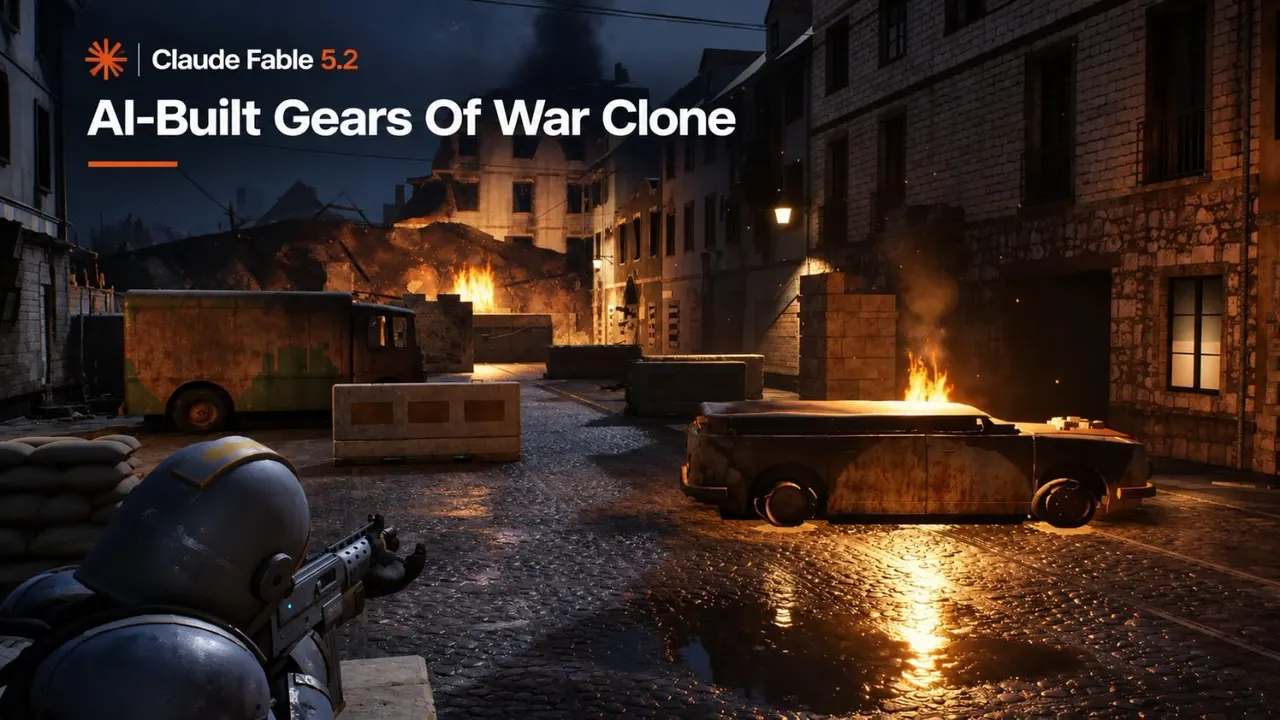
Anthropic's newly released Claude Fable 5.2 is already producing some remarkable demonstrations, and one of the most impressive involves recreating Microsoft's iconic Gears of War franchise. AI researcher and YouTuber Matthew Berman has showcased a playable Gears of War: E-Day-inspired shooter built in Unreal Engine 5, reportedly starting with a prompt consisting of just three lines. In his November 9 video…
Anthropic's newly released Claude Fable 5.2 is already producing some remarkable demonstrations, and one of the most impressive involves recreating Microsoft's iconic Gears of War franchise. AI researcher and YouTuber Matthew Berman has showcased a playable Gears of War: E-Day-inspired shooter built in Unreal Engine 5, reportedly starting with a prompt consisting of just three lines.
In his November 9 video demonstration, Berman plays through a third-person shooter featuring surprisingly sophisticated combat mechanics. The character can sprint, take cover behind environmental objects, lean out to fire at enemies, and perform the signature active-reloading mechanic familiar to Gears of War players.
The enemies demonstrate functional combat AI, while friendly characters can assist the player, including reviving them after being downed. The environment also features detailed architecture, textures, and lighting, which Berman credits to the model.
Impressively, the initial instructions were deliberately minimal. Berman essentially asked Claude Fable 5.2 to reproduce a single level from Gears of War: E-Day in Unreal Engine 5, matching the original game's graphics, gameplay, and characters as closely as possible.
He then enabled Ultra Code mode and allowed the AI to work autonomously, rather than continuously guiding the development process.
However, there is a significant catch.
According to Berman's accompanying report, the project consumed approximately 8.5 billion tokens over several days, with an estimated API-equivalent cost approaching $15,000. More detailed figures reported by Decrypt place the build at 43 hours and 48 minutes, 8.63 billion tokens, and an estimated $14,710.
Crucially, these figures represent estimated API pricing, not necessarily money Berman actually spent. The three-line prompt also shouldn't be confused with a single, instantaneous generation. The model performed an extended development process involving substantial computation.
The demonstration isn't flawless, either. Berman points out some awkward character animations, particularly when vaulting over cover. Furthermore, the footage showcases a single playable level rather than a complete recreation of The Coalition's AAA production. Performance, stability, and long-term maintainability have not been independently evaluated.
Interestingly, the experiment also raises questions about Anthropic's game-cloning restrictions. As Wccftech previously reported, Claude Code received instructions in late October discouraging the recreation of existing games, with Anthropic confirming changes specifically involving Opus 5.5.
Berman's experiment appears to contrast with those restrictions, although it doesn't establish whether the same rules apply to Fable 5.2, particularly under his early-access testing configuration.
Anthropic officially launched Claude Fable 5.2 on November 9, promising stronger coding, reasoning, and visual capabilities, alongside output generation up to 30% faster than its predecessor. The company charges $8 per million input tokens and $40 per million output tokens through its API.
For now, Berman's experiment offers an impressive glimpse into what increasingly autonomous AI coding agents can accomplish. It isn't a replacement for professional game development, but producing a functional Unreal Engine shooter from such limited initial instructions would have been difficult to imagine only a few years ago.
News Source: Matthew Berman on YouTube
Follow Wccftech on Google to get more of our news coverage in your feeds.
Comments
Comments appear after moderation. Persian and English conversations are separate.