
60 years of denial about Israel’s nuclear weapons program confronts a new reality
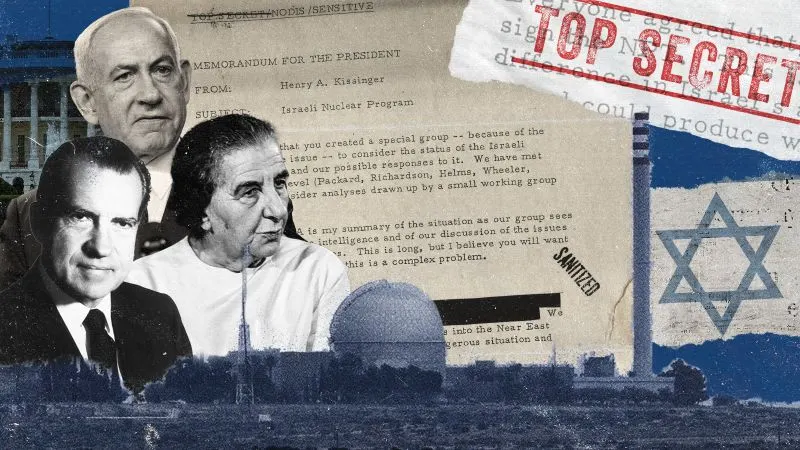
A group of American diplomats was riding in an Israeli helicopter in early 1960 when one of them spotted a construction site rising out of the Negev desert about 20 miles west of the Dead Sea.
The US official pointed and asked the party’s Israeli escort, Addy Cohen from the country’s Finance Ministry, what it might be.
A “textile factory,” Cohen told the Americans, one of whom was US ambassador to Israel Ogden Reid.
What the passenger had spotted was the building of the Dimona nuclear facility, now known as the birthplace of the Middle East’s only nuclear arsenal. It would be several months before Ogden demanded a meeting with Cohen after US intelligence had deciphered the true nature of the construction site.
“Cohen at first treated the matter with levity, (but the) impression came through that he believed (the) reactor could be used eventually for weapons purposes,” said a secret US diplomatic telegram, part of a trove of declassified documents collected by the National Security Archive that also include details of the helicopter ride.
Five years later, US nuclear officials realized a Pennsylvania uranium plant was missing hundreds of pounds of weapons-grade enriched uranium, which some US intelligence officials argued and a recent documentary suggested was diverted for use in the Israeli program.
For the 60 years since, the US and Israel have played coy, neither acknowledging the development of Israel’s nuclear arsenal. When Israeli officials want to wink towards the country’s weapons, Addy Cohen’s ad-libbed response to the American diplomats now serves as a popular euphemism. Israeli Prime Minister Benjamin Netanyahu referenced a “textile factory” meeting with the country’s Atomic Energy Commission head in a July 14 speech.
It has morphed over time into the world’s “worst kept secret,” as Israeli-American historian Avner Cohen has described it. The policy observed by the US and Israel is now one of opacity or ambiguity — hinting at, but never formally confirming, Israel’s nukes.
The policy has helped the US maintain a public stance against additional countries developing nuclear weapons and helped Israel avoid questions about how (or whether) it got the bomb.
But that stasis may be shifting as other countries in the region advance their nuclear programs. The US and Israel are waging a war against Iran in part to prevent Tehran from acquiring a nuclear weapon — and top nuclear nonproliferation experts argue those efforts may be futile. Meanwhile, a nuclear cooperation agreement between the US and Saudi Arabia is pending before Congress.
The once ironclad support for Israel’s military ambitions may be starting to corrode in the US. On Tuesday, President Donald Trump said that the US may cut off nearly $4 billion in military aid to Israel at the end of the year because “they no longer need it.” And a group of Democratic lawmakers and advocacy groups has been arguing in recent years that it’s time for the US to stop pretending about Israel’s bombs.
Democratic Rep. Joaquin Castro argued, in an interview with CNN, that the US stance of ambiguity towards Israel’s arsenal is an outdated policy that “has become reckless and dangerous.” Castro, a member of the House’s Foreign Affairs and Intelligence Committees, suggested that it’s risky for the US to fight a war alongside Israel and not know “their red line” for nuclear use and “not describe what contingency plans we have in case those weapons are deployed” or if nuclear facilities are hit by strikes.
If the facade of deniability is disposed of, it would force a reckoning over the roots of Israel’s nuclear technology and the years of cat and mouse games meant to prevent definitive proof of the weapons program from emerging. US inspectors never found the secret underground facility beneath Dimona that was used to create bomb-grade plutonium — Israeli officials would wall off its elevator before inspectors arrived, according to a 2024 Hebrew-language TV documentary, The Atom and Me, that included posthumously released interviews with the former head of an Israeli intelligence agency tasked with supporting the weapons program.
Transparency could also further undermine US credibility as it continues to argue against countries joining the nuclear club. It might also trigger economic sanctions or arms sale embargoes designed to punish countries seeking the bomb.
A State Department spokesman said “it is longstanding policy that the State Department does not comment publicly on reports regarding specific platforms and postures.”
The White House did not respond to a request for comment. The Israeli Embassy in Washington, DC, referred CNN’s inquiry to the prime minister’s office, which did not provide a response.
“If Israel were to come out and announce that it were a nuclear power, that may increase pressures on other countries in the region to follow suit,” argued Matthew Kroenig, a nuclear strategist and political science professor at Georgetown University. “A runaway nuclear arms race in the Middle East is not a good thing for US policy.”
In an open congressional hearing in June, Castro pressed Secretary of State Marco Rubio on the subject.
Rubio, who after Henry Kissinger is only the second American to serve simultaneously as top diplomat and national security adviser, provided perhaps the frankest public assessment that any US diplomat ever has on the matter.
“I think most of the world assesses that they do, but we’ve never — they’ve never, acknowledged that publicly,” said Rubio. “And as a feature of our foreign policy, for a variety of reasons, we don’t discuss it in that way, either.”
Building Denial
The secrecy policy originated from Cold War necessity, experts argued to CNN. Both the US and Israel feared sparking Soviet-sponsored Arab nuclear weapons programs, and Israel feared the diplomatic consequences that would follow publicly becoming a nuclear weapons state.
The same year that the Pennsylvania facility first realized it was missing uranium, Kissinger made a trip to Tel Aviv and debriefed senior American mission officials at the US embassy about conversations he had had with the Israelis. Kissinger, then a professor in Harvard’s Department of Government, was a foreign policy advisor to significant Republicans. He would assume the role of national security advisor in the Nixon administration less than four years later in 1969.
According to a declassified memo in the National Security Archive summarizing the conversation, Kissinger “had a strong belief that Israel is already embarked on a nuclear weapons construction program” — something that President John F. Kennedy had tried to prevent.
He had met with Israel’s deputy defense minister Shimon Peres and found Peres and other key officials in favor of building nuclear weapons. There also “was no question even among the scientists about Israel’s need to develop them,” the memo said.
But there was a curious angle — Kissinger said he believed Israeli officials believed it important that they “not appear to introduce (nuclear) weapons to the area.”
According to Cohen, a preeminent historian of Israel’s nuclear program, US and Israeli officials sought to “blur” the line about what “introduce” meant, and the two sides didn’t agree on the definition of a nuclear weapon. Israel believed that a weapon needed to be tested and publicly declared before it could be considered “introduced,” Israeli Ambassador Yitzhak Rabin told US officials in a November 1968 conversation during negotiations over the sale of advanced F-4 Phantom fighter jets.
US officials were gravely concerned that a public Israeli arsenal would cause Arab countries — many of which were smarting from their defeat in the 1967 Six-Day War — to actively seek nuclear weapons or security assurances from the Soviet Union. In a report attached to a July 1969 Kissinger memo to President Richard Nixon, top American officials concluded that Israel’s acquisition of nuclear weapons would “substantially increase the probability that someone will use nuclear weapons in anger.”
But Kissinger realized that the US likely couldn’t stop Israel, even if Nixon threatened an arms embargo. Blocking arms deliveries while keeping the nuclear program secret would likely infuriate Congress and result in a domestic political crisis. Calling out Israel’s weapons program to create diplomatic pressure could lead to Soviet and Arab allegations of American complicity.
The solution, then, was to lean into the ambiguity of the situation. Israel also declined to sign the Treaty on the Non-Proliferation of Nuclear Weapons.
“What we really want at a minimum may be just to keep Israeli possession from becoming an established international fact,” Kissinger said in the memo.
The July 1969 Kissinger memo doesn’t record Nixon’s decision, and there seemingly isn’t official documentation of the moment that atomic ambiguity became joint US-Israeli policy.
Cohen argued that Nixon and new Israeli Prime Minister Golda Meir must have agreed on ground rules for the nuclear program after a one-on-one White House meeting that took place without aides in September of that year. No written record of their discussion is known to exist, but a later memo from Kissinger to Nixon referenced the president’s “private discussions” with Meir and noted that Nixon’s “primary concern was that the Israelis make no visible introduction of nuclear weapons or undertake a nuclear test program.”
After that meeting, US pressure on Israel regarding nuclear weapons development virtually ceased.
In the 1970s a combination of press reports and accidental government disclosures strongly suggested that Israel had developed the bomb, but in 1986 any international doubt vanished when Mordechai Vanunu, a former reactor technician at the Dimona plant, detailed Israel’s nuclear program and shared secretly taken facility photographs with the Sunday Times newspaper in London.
Shortly before the newspaper published the exposé, a young Mossad agent lured Vanunu to Rome, where the Israeli intelligence service drugged him and placed him on a secret Israeli Navy cargo ship waiting in international waters, according to a 1999 book written by Peter Hounam, who had been the reporter behind the investigation.
Despite Hounam’s testimony in his defense at the highly publicized trial, Vanunu was convicted of treason and espionage-related charges and spent 18 years in an Israeli prison, most of it in solitary confinement.
The end of the Cold War eliminated much of the original rationale for Israel’s nuclear ambiguity policy. Israel no longer faced a credible existential threat from the Arab states with the Soviet Union no longer a potential instigator of regional nuclear proliferation. The change in circumstances made Israeli officials nervous, the New Yorker reported in 2018, leading them to secretly seek and receive written assurances that the US wouldn’t ask them to disarm — appropriately vague, in line with the ambiguity policy — beginning with President Bill Clinton’s administration.
Some of the secrecy has subsequently relaxed. Government censors in Israel permit some discussion of nuclear weapons if publishers include a disclaimer line — “according to foreign reports.” Netanyahu, when pressed about his country’s nuclear capabilities in a 2018 CNN interview, did not deny them but instead reiterated that Israel “won’t be the first to introduce” them to the region.
But the official position remains that neither the US nor Israel confirm that the latter has nuclear weapons, despite the Nuclear Threat Initiative non-profit estimating their arsenal to include 90 warheads.
Can denial be undone?
Rubio’s June statement and increasing pressure from some US lawmakers indicate that the posture of denial may be unraveling, adding another element to tensions in the Middle East already elevated by the war with Iran and Houthi military advances in Yemen that have threatened shipping through the Red Sea, among others. It’s also unclear how Trump’s planned reduction of military aid might impact the ambiguity policy.
Kroenig, who is also the literary representative for Kissinger’s estate, argued that Iran’s “more overt program” has already led regional countries like Saudi Arabia to “hedge.”
Saudi Arabia’s de facto leader, Crown Prince Mohammed bin Salman, has repeatedly threatened to build nuclear weapons if Iran gets the bomb. A nuclear deal between the US and the Saudis currently under congressional review would provide a pathway for the kingdom to enrich uranium on its own soil if specific conditions, including US approval, are met.
After months of war with the US and Israel, Iran still holds nearly 1,000 pounds of highly enriched uranium despite its elimination being a major US and Israeli war aim. Although much of that uranium is buried in facilities struck by American bombers last year, nonproliferation expert James Acton of the Carnegie Endowment for International Peace told CNN he believes “there’s a 50-50 chance that Iran gets the bomb” within the next three years.
Castro, the Texas congressman, agreed that US ambiguity towards the Israeli arsenal was once a good policy, but he believes that the time to abandon it has arrived.
“A lot has changed since those years of the [19]50s, [19]60s, and [19]70s,” he said. “It’s a very different geopolitical world than it was back then, but the [ambiguity] policy never changed.”
In Kroenig’s eyes, an Iranian nuclear test is an “obvious” scenario in which the US and Israel should abandon their ambiguity policy.
If Iran were to build a weapon, Kroenig argued, Israel would need to publicly talk about its nuclear strategy and policies and do military exercises to create a “credible” nuclear deterrent against Tehran. But beyond that contingency or another regional rival acquiring the bomb, he doesn’t think that the US and Israel should acknowledge the Israeli arsenal yet.
Castro, in his Capitol Hill back-and-forth with Rubio in June, argued that even one-sided possession of nuclear weapons in the Israel-Iran rivalry poses enough concern to merit public discussion. He raised concerns over what Israel’s “red lines” may be for nuclear use with US troops deployed in the region.
Rubio demurred, suggesting that he could speak more freely in a classified meeting.
“These things require delicate balancing acts between different equities,” Rubio said.
Davis Winkie’s work at CNN is supported by a partnership between Outrider Foundation and Journalism Funding Partners (JFP). CNN retains full editorial control of the reporting.