
‘We need to get to work’: Democrats debate what to do with their midterm mandate
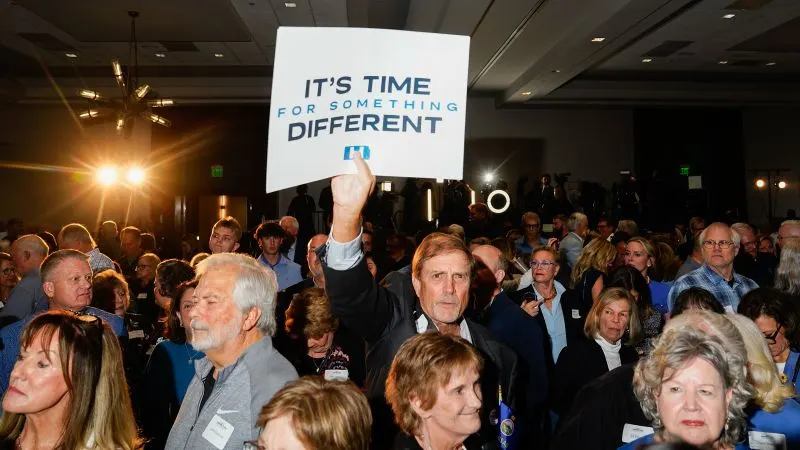
What comes in a wave: So many Democrats winning means so many people were right about what they needed to do to win, that their claimed lessons directly contradict each other.
Is the model for Democrats the brash Egyptian American doctor who ran on big promises like Medicare for All and talked throughout his victory speech about Michiganders suffering through higher costs because of money sent to Israel for the war in Gaza?
Is it the mild-mannered Presbyterian seminarian who talked about Jesus and also border enforcement — while splitting the difference on Israel — to lead a Democratic takeover of Texas after the party went 32 years without winning a statewide race?
Is it the Jewish governor of a swing state who talked up a pragmatic, reach-across-the-aisle record and won by 20 points while also carrying four swing House seats and majorities in both chambers of the state legislature?
“I don’t think it’s about left or middle or center – I think this is about listening to people,” Pennsylvania Gov. Josh Shapiro told CNN in a phone call on Wednesday afternoon. “They are disgusted about the chaos, the cruelty and the corruption. They do not want to be told what to do by a group of small, selfish men who are plundering our nation — and they put Democrats in charge to change that.”
Abdul El-Sayed, James Talarico and Shapiro are all resounding winners coming out of Tuesday’s midterms, which delivered once-unthinkable results like a Democratic senator from South Carolina, the first Black woman governor in history elected in Georgia, and a sweep of midwestern states that voted three times for President Donald Trump.
Amid the euphoria, Democrats are now debating how to make these midterms different from other elections where politicians’ promises fall short — and how to position themselves for a post-Trump era that may arrive faster than anyone may have thought thanks to Tuesday’s results.
“There’s not just fury at what Republicans have done wrong, but an invitation for Democrats who need to earn the trust of the American people to do so by getting in there and focusing on the things that have motivated people to go to the polls,” said Pete Buttigieg, the former transportation secretary and likely 2028 contender, after speaking at the Michigan Democrats’ joint party, where every few minutes a DJ interrupted the music to call out each big win.
Buttigieg urged Democrats to move quickly on formalizing an agenda.
“It’s taking stock of all of these 2-to-1 issues that most Americans agree on — that all Democrats agree on, that many Republicans agree on, and that Washington Republicans are energetically against,” Buttigieg said, listing raising the minimum wage, expanding Medicaid and the child tax credit, and political reforms limiting money in politics and gerrymandering. “If we do them in a rapid-fire — I’m thinking [bills called] HR 1, 2, 3, 4 all the way to 15 — that will show the Democrats are taking seriously the issues that sent them into office and daring the White House to get in their way.”
Trump is still president for two more years and there’s no way to legislate to the lower prices many voters said drove them to vote for Democrats, especially if they can’t find a way to work with him.
Massachusetts Sen. Elizabeth Warren, the progressive agenda-setter who spent the final day of the campaign enthusiastically stumping for El-Sayed around the state, said that goes up to and including working on bills with Trump, if the president wants.
“There’s a good place to go for healthcare, tax fairness and childcare,” she said. “Some very popular bills, like surveillance pricing — that’s a place that we put it on the floor and say to the Republicans, ‘Put up or shut up.’ Stop the war halfway around the world. We’ve got the power of the purse. We can’t do everything, but damn, we can do a lot, and we better.”
Rep. Adam Gray, who, thanks in part to California redistricting, won his second term by 20 points after winning his first in 2024 by 187 votes, said the lesson for Democrats is in not governing like the Republicans the last two years. To him, that means means action on nitty-gritty items like permit reform on energy infrastructure and cutting wait times at Social Security offices, while getting people more money by raising the minimum wage.
“If we don’t find ideas that work and nobody’s life gets better or easier to navigate,” Gray said, “then voters are going to tire of us too.”
Touting his own resounding win in “the toughest swing state in the entire country,” Shapiro pointed out that now 9 of the 10 largest states will have Democratic governors, and many House districts that went with Trump two years ago will be represented by Democrats too.
“We now have the keys to the car,” Shapiro said, “and we have to drive it responsibly.”
One challenge: Every Democrat sees validation
Here in Michigan, a state that is in many ways a microcosm of the electorate the last 10 years, Democratic leaders themselves aren’t sure exactly what to make of a race that generated extreme interest and encouraged El-Sayed to declare to a large crowd that stuck around until 2 a.m. that he was going to use his seat “to transform our politics.”
One of El-Sayed’s running themes through his victory speech is what an unlikely candidate he was — a trained doctor turned public health official, running to become the first Muslim ever elected to the Senate with a very long and undeniably Arabic name. Republicans — and some Democrats — thought he would put the Senate seat in danger with his support of far-left priorities like Medicare for All, his challenges during the primary with Black and Jewish voters, and his alliance with prominent democratic socialists like Sen. Bernie Sanders and Rep. Alexandria Ocasio-Cortez.
Instead, he called his shot and hit the 7-point win he predicted beforehand — though less than Michigan Gov.-elect Jocelyn Benson, who won by 11 but also had to be rushed from shaking hands with supporters after her victory speech so that El-Sayed could take the stage to a more raucous reception.
Abby Squires, a 35-year-old Lansing resident, spoke to CNN after voting for Benson, El-Sayed and Rep.-elect Will Lawrence. Squires said she wants Democrats to take her vote and others as calls to move quickly on healthcare, education and assistive technology for the disabled.
“It’s important to hear from the people that these policies are actually affecting,” Squires said.
Lawrence beat out two more moderate Democrats in the August primary then on Tuesday edged out incumbent GOP Rep. Tom Barrett after quitting the Democratic Socialists of America and trying to modulate himself going into November.
In an interview with CNN shortly after voting for himself in the basement of the First Presbyterian Church, Lawrence — who, like El-Sayed, was being trailed by a three-person documentary crew — said that while he saw a victory as a validation of turning away from taking corporate donations, he’s also reading it as a call for fast and concrete moves.
“We can take action immediately to restrain the president’s out of control tariff agenda, which has caused prices to go up nowhere more than here in Michigan. We can also take action to reverse the disastrous cuts that have been made to the Affordable Care Act, as well as Medicaid,” Lawrence told CNN.
Elissa Slotkin narrowly won Michigan’s other Senate seat two years ago against the same Republican candidate as El-Sayed while running a very different campaign. The senator, who has spent much time since traveling the country telling Democrats they need to pursue a more moderate path — and stoking chatter of a 2028 presidential run on her argument, declined an interview request on Election Day to discuss what she was taking away from this race.
But on Monday afternoon, Slotkin popped into an El-Sayed event in Flint, insisting that she and her now soon-to-be colleague “agree on the important things.” Then El-Sayed took the stage to enthusiastic cheers from both a recently laid-off 68-year-old local named Erin Moss and a second-year law student of Iranian descent who arrived from New York wearing a Palestine soccer jersey and keffiyeh draped around his shoulders.
Maurice Mitchell, the national director for the left-leaning Working Families Party, said that’s why of all the races in the country, he spent the final days of the election pushing for El-Sayed in Michigan, as he had during the primary.
“What it says is that we are absolutely in a populist anti-establishment moment, and candidates like Abdul can win everywhere. And I think that changes the political calculus for everything,” Mitchell told CNN in the parking lot after El-Sayed’s event Monday in Flint. “Working-class people are screaming, as loud as they can, ‘We cannot afford to live in this country and we need immediate relief!’”
Mitchell said that leaves him hopeful, with a warning.
“We might be on the verge of actually participating in a political realignment in this country,” he said, but “if the Democratic Party doesn’t choose to lead this populist moment, there’s a bunch of right-wing populists who would be more than happy to do that.”
Many of the Michiganders who voted for El-Sayed said they were convinced by his more basic talk of costs and unity that he campaigned on through the final weeks.
Semira Sharif, a nurse from Farmington Hills who came to El-Sayed’s event on Monday in the hall usually used as the Royal Oak farmer’s market, said she’s tired of the pain she hears from the seniors she works with or her teenage children who don’t have jobs.
“If he wins, at least we will have Medicare,” Sharif, who immigrated from Ethiopia 45 years ago, told CNN. “It’s not just one race is hurting. It’s everyone: Black, White, Asian, Jews, Christians.”
The path for the 2028ers
One of El-Sayed’s running themes through his victory speech is what an unlikely candidate he was, even though he had previously run for governor. At a moment when feelings of being abandoned by politicians is high, that anti-politician vibe ties him together with lots of other Tuesday winners, from Methodist minister Adam Hamilton who won a Senate seat in Kansas to Tejano music star Bobby Pulido and smokejumper Sam Forstag, who flipped House seats in Texas and Montana.
That will be hard to match for any of the longtime officeholders who are currently gearing up to seek the Democratic presidential nomination — just as mashing a collection of non-politicians into legislating starting in January won’t be easy. Incoming House Speaker Hakeem Jeffries will have a bloc of democratic socialists in his membership but also a newly enlarged Blue Dog Coalition of moderates.
But if Democrats want to win the 2028 and 2032 presidential elections — and if they want to keep the control they won of the House and the Senate — they’ll have to manage both feats.
A person close to Ocasio-Cortez forecast earlier in the year to CNN that her potential appeal and appetite for a presidential campaign would be “put to the test in the coming months: Will Democratic candidates in tough races recognize she is a net positive for their campaign?” She ultimately made a handful of appearances, both with ideological allies and more moderate Democrats like Rep. Eugene Vindman of Virginia.
An Ocasio-Cortez aide argued to CNN that she did campaign in tough races, including for winning Maine Senate candidate Troy Jackson, but did not respond when asked whether she hadn’t gotten more invitations or whether she declined some of those she got.
But all of the wins mean that the congresswoman but also other potential 2028 contenders — from Buttigieg to Shapiro to former Vice President Kamala Harris and as many as two dozen others — can claim a hand in a significant midterms victory.
Even Bill Clinton, who lived through his own massive midterm repudiation in 1994, was in Tupelo last Friday to help stir up enthusiasm and legitimacy for Scott Colom, who’s locked in a tight race for Mississippi’s Senate seat.
“Some days I hardly recognize the country I have loved so much all my life. The corruption, the ego projects,” he said in Tupelo, adding, “they like checks and balances as they define them. They get the checks, and we pay the balance.”
On Wednesday, Clinton wrote his own statement warning his party not to get too caught up with the scoreboard and think of Tuesday as “an opportunity and responsibility to rebuild trust.”
“Yesterday was a great day for our democracy,” he wrote. “If we want to hold on to what we’re feeling today, we need to get to work.”