
The Legend of Zelda: Ocarina of Time Is Still Perfect on Switch 2 | Review
As the time-afflicted Link comes to learn in the seminal Nintendo 64 classic, a lot can change in seven years. Shifting political struggles leave a neighborhood in total disrepair. That one local eccentric he came to love is nowhere to be seen. There’s a Starbucks — or an archery range, I mean — in town now. Seriously? But underneath the jarring changes that taunt your memory, you know that the place that you love…
Somewhere among all its gods and ghosts, The Legend of Zelda: Ocarina of Time draws its true power from its human center: a familiar story about growing up and returning home after a long absence.
As the time-afflicted Link comes to learn in the seminal Nintendo 64 classic, a lot can change in seven years. Shifting political struggles leave a neighborhood in total disrepair. That one local eccentric he came to love is nowhere to be seen. There’s a Starbucks — or an archery range, I mean — in town now. Seriously? But underneath the jarring changes that taunt your memory, you know that the place that you love is still there. You can feel its heart beat when you plant yourself in the shade of that tall tree you played around as a kid.
It’s what makes the concept of an Ocarina of Time remake so challenging, but impossible to resist. How fitting — fated even, written in stars and ancient code — to bring generations of adventurers back to the sprawling field where they first learned to run. Like your hometown, a game as foundational as this is perhaps meant to be revisited throughout a lifetime rather than locked away in your long-term memory.
Nintendo doesn’t squander the opportunity for a meaningful homecoming in its lovingly crafted Switch 2 remake. The timeless classic is still a joy to reappraise in its dazzling new form, even if some of its modern developments might send protective fans marching to town hall. Yes, there’s a Starbucks where that quaint café used to be now, but Ocarina of Time’s soul still shines bright enough to guide you home.
What’s new?
One part faithful remake and one part modern retelling, the new version of Ocarina of Time is bound to take old players off guard in its opening moments. The story is unchanged: After getting paired with a fairy, Navi, for the first time, a young Link gets swept into a kingdom-trotting quest to save Hyrule from the nefarious Ganondorf. The sequence of events is unchanged from the original, but the presentation is very different. The Switch 2 remake leans into the fairy tale nature of the original game with storybook narration that clearly lays out the “legend” being told. It’s a smart bit of narrative framing, emphasizing that Ocarina of Time is a story meant to be passed down and retold like a fable.
What’s less successful, at least initially, is fully-voiced new dialogue that replaces the comparatively sparse text boxes of the original game, which featured no voice acting outside of a few stray grunts. An opening conversation between Navi and the Deku Tree, Hyrule’s guardian spirit, loses its moody texture in a brightly-lit cutscene where a squeaky-voiced Navi lays out all the exposition you need to know. It’s a common struggle that Nintendo faces anytime it tries to give its games a cinematic treatment; the more you scale a game like Star Fox 64 up, the more it starts to look like an Illumination-flavored animated kids movie. It’s no wonder that Nintendo saw enough of itself in the Minions studio to entrust it with Mario.
That change in energy takes some getting used to, as an introductory jaunt through Kokiri Forest teases a remake that has been overly polished to a modern sheen. That opening is more tutorial-heavy now, for instance — and that’s saying a lot considering that Navi is gaming’s original hand-holder. It’s not enough for a Kokiri child to tell you how to use your sword anymore; you now need to perform each action multiple times in a practice session before you’re trusted to explore your first dungeon. Those small changes have a way of stacking up early on, creating a shaky first impression as you learn all the ways an old favorite has changed.
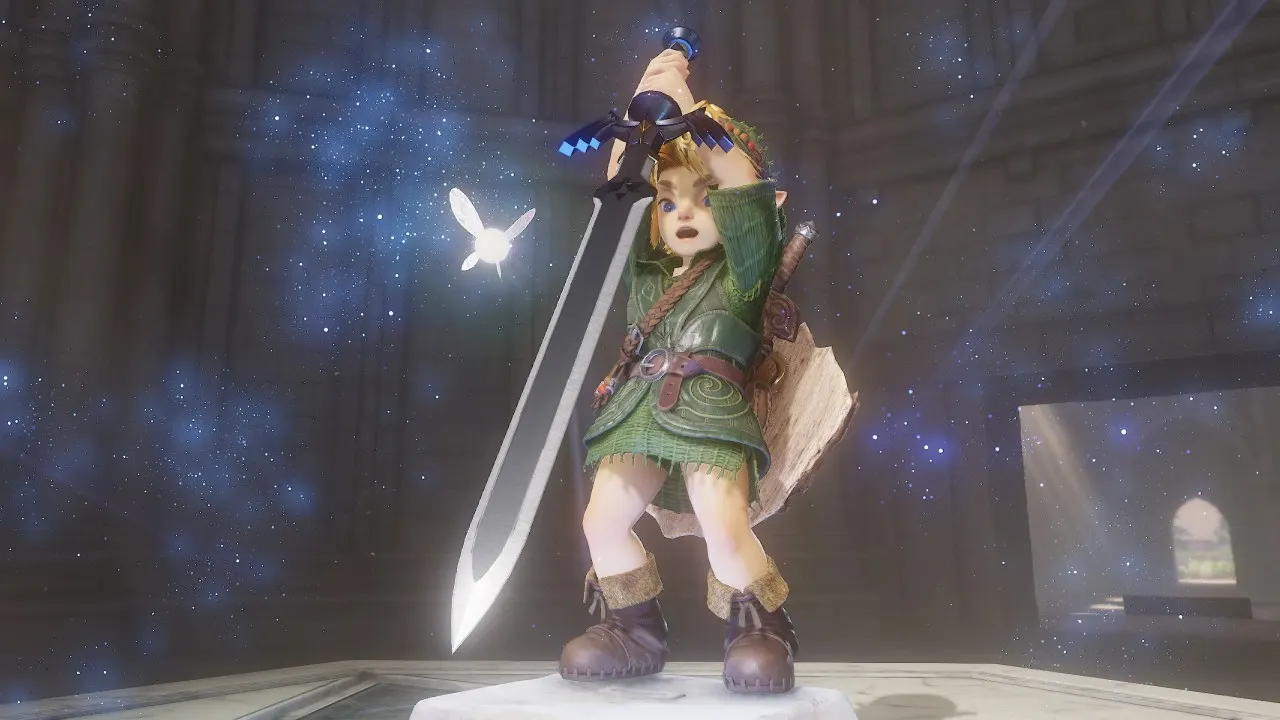
But part of growing up is learning to accept, and even embrace, change. That’s where the remake’s controversial visual overhaul makes a statement. When the game was first revealed with a short teaser, it was met with some immediate disgust from players who feared that Nintendo was trading in its cartoon charm for flat Unreal Engine realism. That snap judgment is destined to age like Lon Lon Milk, because the remake is both highly stylized and stunning in motion. That’s apparent right off the bat when strolling through the dreamy Kokiri Forest, with streaks of light poking through the thick roof of greenery that protects the town. It’s a dreamy and nostalgic sight that sets the right tone for the rest of the adventure, one that has the emotional resonance of dusting off an old picture book you read as a kid.
What’s miraculous is how Nintendo is able to retain the grandeur of the world without scaling its locales up beyond recognition. Hyrule is compact by modern game standards, split into only a few tightly designed areas, but it still feels sweeping here. The open air of Hyrule Field is still breathtaking to take in, emphasized with more detailed grass instead of needless space-filling activities. Lake Hylia is just a round body of water, but the glistening light reflecting off of it makes it feel like a cool, serene getaway. Even Kakariko Village’s graveyard benefits from minor changes, with once low-poly headstones now detailed with embellishments that invite you to pull them to reveal the secrets buried underneath them. The only area that really loses some of its former aura is Hyrule Castle Town, as the pivot to smooth 3D camera controls does away with eerie fixed camera angles that were once so important to selling the village’s eventual decay.
If there’s an issue to take with the visual design, it’s that it can be inconsistent. While the detailed environments look spectacular, they aren’t exactly a match for the smooth character design. Link looks like a porcelain doll in hand-stitched clothing, which is a thematically appropriate choice that once again gets at an old childhood toy feel. It’s just a shame that the world doesn’t have a dollhouse look of its own to suit that style. Maybe that’s what has left fans so split as they see Princess Zelda’s glassy eyes or a hookshot that looks like a clay miniature contrasted against a more natural world.
Throughout Ocarina of Time, anything that felt off at first glance grew on me over time, especially once Link himself grew up in the story’s iconic turning point. The natural swap from a hokey animated cartoon to a Grimm’s fairy tale locks every artistic choice into place. The directed cutscenes become a highlight once Link is having tender musical duets with the mysterious Sheik. The reimagined visuals pay off once you get to see monsters like Redeads and Like Likes in their horrifying new forms, emphasizing Ocarina of Time’s roots as a true horror game. Freshly reorchestrated music makes everything feel more operatic without rewriting melodies that now feel as standard to musical canon as “Ode To Joy” — at least if you grew up humming “Zelda’s Lullaby.”
As jarring as the remake’s clean sheen can feel next to the meaningfully grungy Hyrule of olde, the changes don’t get in the way of what makes Ocarina of Time special. And how special it still is 27 years later!
Reinforcing the foundation
While much has changed from an aesthetic standpoint, Nintendo is very careful not to adjust much about the adventure outside of handy quality of life tweaks. The addition of a dedicated jump button is an inoffensive touch, and Nintendo makes good use of modern controller layouts to make item swapping more seamless (even if Breath of the Wild’s dreaded horizontal item menu returns here), but the core of the game remains wisely unchanged. You still trek between locations across two ages, clearing elemental-themed dungeons full of monsters and puzzles, and obtaining items that gradually open up the world. It’s a structure that inspired an entire genre of adventure games in 1998, but the Switch 2 remake reaffirms that no game has ever nailed that formula as well as Ocarina of Time.
Upon revisiting the story for the first time in two decades, I came to appreciate so much about a game I thought I had mastered years ago. What immediately stands out about Ocarina of Time next to modern games — even modern Zelda games — is how not a moment feels wasted. Every interaction with a jolly Goron feels meaningful, hand-placed there for a reason. Every side-quest, minigame, or hidden grotto feels bespoke, like it was sculpted to contain one memorable secret. A gaggle of singing frogs perched next to a river, a pair of scarecrows baking in the sun, a diving tank in a mad scientist's house. No two activities feel like the result of designers copying and pasting assets throughout the world just to fill a game with more hour-eating busy work. It stands in proud contrast to modern adventure games that do so much less with so much more.
There was never a dull moment in my 20-hour playthrough, even when I was backtracking across Hyrule Field or up Death Mountain. That’s made possible in part thanks to Ocarina of Time’s fantastic dungeon design. Each one is a perfectly crafted puzzle box that builds unique enemies and challenges around the dungeon’s theme and key items. Navigating twisted hallways in the Forest Temple with your newly-discovered arrows or cutting your way out of an oversized fish belly is always a surprising delight that feels unlike anything you’ve done before. The remake keeps all of those iconic dungeon designs intact, only making some welcome tweaks to the dreaded Water Temple to make it easier to navigate at a glance. I have to wonder if the remake partially exists as a way to wean players off of Breath of the Wild’s open-world freedom, and reignite a desire for something crafted with more precise intent.
What I appreciate most of all is Nintendo’s restraint. It remains confident in the original game’s design, understanding that Hyrule Field doesn’t need to be an immersive playground full of new secrets to evoke an emotional response from new players. There’s a version of this remake in an alternate timeline that goes full Halo: Campaign Evolved, overhauling entire systems to bring an old game in line with its modern peers at the expense of the original game’s ethos. Nintendo largely rejects that, and that choice always pays off.
What a relief it can be to play something like the Ocarina of Time remake and find that the magic is still there.
Look to the remake’s swordplay for a shining example of that. Nintendo could’ve easily followed modern trends and buffed up Link’s move set by giving him a parry, a time-slowing dodge, or more sword-slashing combos to use against spongy enemies with bigger health bars. Instead, the remake sticks to the fundamentals of slashing and dodging to retain the Punch-Out!! style dynamics of Stalfos duels. Rather than aiming for artificial complexity, the remake puts its focus on giving every motion more feedback. When you land a successful slash on an enemy, you’re rewarded with a fireworks flash of particles and a grand slice sound to give your strike power. Even taking out a simple Deku Baba feels like a heroic act. It’s the best that combat has felt in a Zelda game since Wind Waker, and it’s accomplished by reinforcing the foundation instead of pulling up the floorboards.
That’s the strength of the remake at large. Like a good fable passed down through oral tradition, the heart of the tale remains intact; all that’s really changed is the embellishments. Little changes to room layouts in dungeons or exaggerated duels are akin to a storyteller putting their own flourishes on a story to make the fiery Volvagia sound like an even fiercer foe. It’s hard to lose the spirit of Ocarina of Time in that game of creative telephone because every word of it is unforgettable.
Coming home
The Ocarina of Time remake’s technical excellence has nothing to do with why the adventure is actually special, of course. Revisiting Ocarina of Time feels a bit like plunging the Master Sword back into its pedestal in the Temple of Time; I’m young Link again, back in the peaceful shade of Kokiri Forest where I grew up. Part of that is because the original Ocarina of Time is so closely tied to my hometown; the first video game review I ever read was written by my late friend Andrew for our 4th grade newspaper. To me, Hyrule is a small town in Massachusetts, and I have always felt a fierce loyalty to it because of that.
There’s a sensitivity that comes with that, one that I’m sure many players feel when a meaningful piece of media from their childhood gets reappraised. Over the last two decades, I’ve watched the cultural consensus on Ocarina of Time shift from hailing it as an untouchable classic to a dated N64 game that downright sucks to play. I’ve always felt a protective instinct kick in every time a new player dips into it for the first time and starts complaining about this or that. You weren’t there! You couldn’t understand!
The reality is that I know it’s a defense mechanism. I’ve spent decades now scared to replay Ocarina of Time for fear that I won’t like what I find. Maybe I’ll find that it’s changed too much — or, worse, maybe I’ll find that I have. It’s not dissimilar to how I used to feel about coming back to my hometown after college; there is a discomfort in returning to something that once felt magical only to discover it’s small and mundane in the context of a wider world. Maybe that’s why video game remakes often elicit such strong reactions from players who lament their very existence or gasp at every minor change. It’s easier to protect the past by locking it up in our memories.
So what a relief it can be to play something like the Ocarina of Time remake and find that the magic is still there. Any fear I had that its design would feel antiquated or that a glossy visual overhaul would pave over its plucky spirit disappeared the first time I whistled out the jaunty notes of “Saria’s Song,” like a kid discovering how to make music for the first time by tooting out “Hot Cross Buns” on their dinky recorder. The world of Hyrule felt every bit as big and beautiful as I remembered, so full of discoveries for anyone curious enough to take a wrong turn in the Lost Woods.
Get Polygon’s Wishlister newsletter
A weekly cheat sheet to what you’ll eventually love to play. No buying, no commitment — just saving for later.
Sign up free
Free. Unsubscribe anytime.
I’ve spent the better part of my life hearing people repeat the claim that Ocarina of Time is the greatest game of all time. At some point, it starts to lose all meaning, like saying The Beatles are the best band of all time based solely on an accepted cultural consensus. But the Switch 2 remake reminds us why Ocarina of Time earned that accolade in the first place. Set aside any nostalgia and you’ll still be met with a big-hearted fable set in a lively fantasy world filled with characters who are as familiar as close friends. Link’s journey to adulthood and back again remains a meaningful odyssey about finding the courage to save the soul of the place that lives in your heart — a love that transcends time itself. Every word in my friend’s 4th grade assessment of that epic adventure he connected with as a kid still applies here, and that’s a testament to what could have been a soul-crushing double dip.
That’s the intangible thing that I look for in a remake, something personal that’s hard to articulate in a technical breakdown. Forget the jump button or the smooth framerate: Does The Legend of Zelda: Ocarina of Time still feel like home? Yes, it does, even with a few changes that trigger a “back in my day” reaction. I’m no longer afraid of returning to Hyrule Field and watching the sun set again. I’ve only grown to appreciate the peace and quiet more with age.
The Legend of Zelda: Ocarina of Time will be released Nov. 5 on Nintendo Switch 2. The game was reviewed on Nintendo Switch 2 using a prerelease download code provided by Nintendo. You can find additional information about Polygon’s ethics policy here.