
‘Romería’ Director Carla Simón Would ‘Love’ to Collaborate With Rosalía Following Latin Grammy Nomination for ‘Flamenco’
In May, as part of a banner year for Spanish cinema at the Cannes Film Festival that also included Los Javis’ award-tipped “La Bola Negra” and Rodrigo Sorogoyen’s “The Beloved,” Audiovisual From Spain presented three short films as part of their Where Talent Ignites campaign to showcase the strength and diversity of national talent. “Alcarrás”
In May, as part of a banner year for Spanish cinema at the Cannes Film Festival that also included Los Javis’ award-tipped “La Bola Negra” and Rodrigo Sorogoyen’s “The Beloved,” Audiovisual From Spain presented three short films as part of their Where Talent Ignites campaign to showcase the strength and diversity of national talent. “Alcarrás” director Carla Simón was among the selected filmmakers, and her striking short film “Flamenco” went on to be nominated for a Latin Grammy in the Best Longform Music Video category.
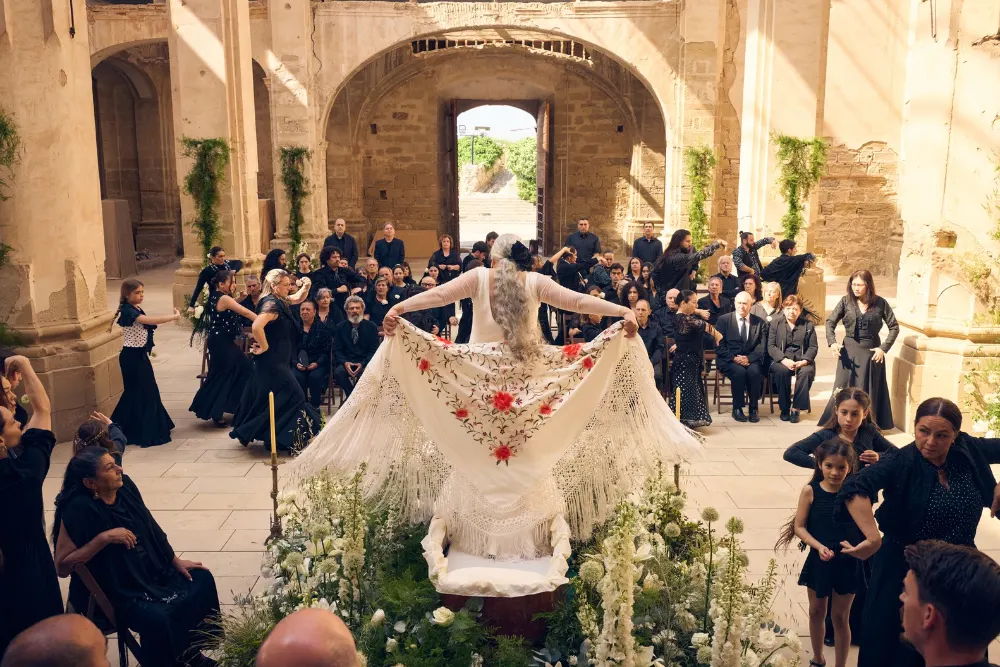
“Flamenco” presents a riveting blend of modernity and tradition, portraying flamenco as an art form tied to the core of Spanish culture and emotion. The film stars Rocío Molina, a renowned dancer and choreographer famous for reinventing the flamenco tradition and whose work combines this very dance between yesterday and today. Molina won Spain’s National Dance Award, the Silver Lion at the Venice Biennale and the Gold Medal of Merit in the Fine Arts, establishing herself as one of the most influential creators on the contemporary performing arts scene.
So has the Latin Grammy nomination sparked Simón’s curiosity to move further into the world of music, perhaps directing a few music videos? “Yes, of course,” she tells Variety. When asked about the success of music videos like Rosalía’s “Berghain,” the director jumps in to say she is a massive fan of the Spanish singer. “I would love, love to work with Rosalía. I hope it happens someday.”
“It’s another language, but very close to cinema, and coming from cinema I think you can bring a different look to music videos. I would love to direct more music videos someday,” she adds.
As for the Latin Grammy nomination, the director calls it “a very happy surprise, because it’s not my world.” “I know how cinema awards work, but I don’t know music awards. I found it crazy but very exciting at the same time. When you come from another world, a nomination like that is really something you celebrate.”
Yet before Simón can even think about branching out into music, the director is laser-focused on locking the script for her follow-up to Cannes competition title “Romería.” Simón’s next feature film will also be about flamenco, with the details of the story still under wraps. What the director can say, however, is that her experience with “Flamenco” was “a great help” in the creative process for her next film.
Simón says she “loves” directing short films and always tries to go back to the form after directing a feature. With “Flamenco,” that experience was even greater for the filmmaker, who had the support of an initiative like Audiovisual From Spain, the brand run by Spanish trade and investment body ICEX. “It was a great opportunity because the short was well-financed and I had the chance to collaborate with really interesting people like Rocío Molina, the musicians, the choreographers…. It was so great to work with these people.”
“Short films are a way of trying things out, to play; I feel more free somehow,” she adds. “When you have a longer story, there is a lot about the narrative that you have to work on, you have a producer on board, you’re thinking about how it’ll get to cinemas, audiences…. But when you make a short film, I feel free to experiment and try things out creatively that would be more difficult to do in a feature film.”
The filmmaker notes she learned a lot about movement with the making of “Flamenco,” particularly how to best place her camera to capture the dynamism of the art form. Before they shot the film, Simón, Molina and the choreographers had a mini residency where they explored the dance in the film. “I had written the script, and we needed to understand if the music or the choreography came first and how to move the camera around it. It was amazing, being together for a week and shaping every scene.”
“Flamenco” was shot by “La Bola Negra” cinematographer Gris Jordana, who worked closely with Simón to capture the vastness of scenes like a large funeral procession by a riverbank and the claustrophobic atmosphere of a crowded bar filled with dancers.
“Thinking about the shoot, the procession scene was great because we were in the blue hours, so we didn’t have much time,” recalls Simón. “I also loved the bar scene where everyone is together in a tableau because it was eight in the morning and it was a party. It made me realize flamenco people are always ready to celebrate together. The problem was ending the party [laughs].”
From all she learned with “Flamenco,” the director singles out the “energy” as perhaps the most valuable lesson ahead of writing the feature film. “When you do something with music, and if it’s flamenco, there’s a specific energy.”
“I love flamenco because there is a contradiction in terms of energy and emotion that is very similar to what I look for in my films: this idea of tragedy and pain and something dark existing next to something joyful and celebratory,” she adds. “You have both in one dance – you feel all of it at the same time. It’s contradictory, but possible.”
“Now I am deep in writing and happy to know there is a way of figuring things out in the shoot,” she adds. “It was also beautiful to meet all these people with whom I hope to collaborate again. It’s all very exciting.”
“Flamenco” and all the shorts produced under the Where Talent Ignites campaign are now available on the initiative’s official website.
Comments
Comments appear after moderation. Persian and English conversations are separate.