
Reporter's Notebook: A user’s manual to upcoming leadership elections in the House and Senate
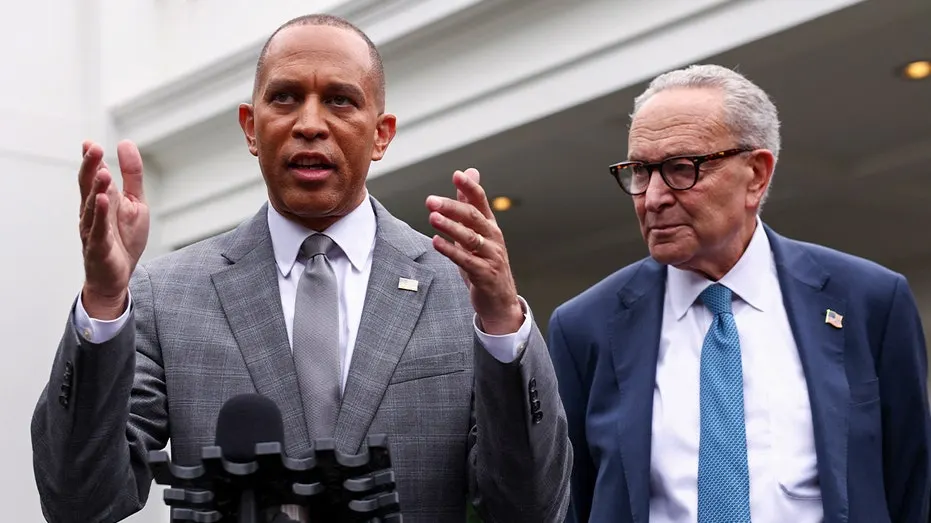
Internal party House and Senate leadership elections are some of the most fascinating exercises that unfold on Capitol Hill. Both House and Senate Democrats and House and Senate Republicans will choose their leaders in the coming days. And the changes are going to be seismic. But not everyone is on board with heir apparent leaders. That’s what makes this process so intriguing. However, there are only two rules in…
Internal party House and Senate leadership elections are some of the most fascinating exercises that unfold on Capitol Hill.
Both House and Senate Democrats and House and Senate Republicans will choose their leaders in the coming days. And the changes are going to be seismic.
But not everyone is on board with heir apparent leaders. That’s what makes this process so intriguing.
However, there are only two rules in leadership elections: You can’t beat someone with no one. And, perhaps more importantly, it’s about the math.
PROGRESSIVES FUME AT HAKEEM JEFFRIES FOR SAYING DEMOCRATS WON'T 'GET EVEN' WITH TRUMP
There are some progressives and DSA-affiliated Democrats who will be House Members next year who want someone other than House Minority Leader Hakeem Jeffries, D-N.Y. Who? Well, no one has said. Again, you can’t beat someone with no one. And, frankly, it’s hard to believe that Democrats would not elect the first Black speaker of the House.
But drill down on the math.
For the sake of argument, let’s say Democrats have 260 House seats in the new Congress. First, Democrats must tap a nominee for speaker in their caucus. That needs a simple majority. So, surely Jeffries will score at least 131 votes in a private ballot for speaker.
The speaker of the House is the constitutional officer for the legislative branch of government, much like the president is for the executive branch and the chief justice of the United States for the judicial branch. Thus, the ENTIRE House votes for speaker when it convenes the new Congress at noon on Jan. 3.
There are 435 members. If all members cast ballots, Jeffries simply needs 218. Jeffries could lose 40 votes or so and still prevail. So, that is not going to happen. It might not even lose more than a couple votes, frankly.
Now let’s look at the GOP and their case for minority leader. House Majority Leader Steve Scalise, R-La., is running against Rep. Jim Jordan, R-Ohio.
If Democrats have 260 seats, Republicans would have 175. All INCOMING House Republicans (including non-voting delegates from U.S. territories) are allowed to vote in CONFERENCE. The selection of minority leader does NOT go before the entire House like speaker. So, the winning candidate only needs a simple majority. That would be 88.
The same for the race between House Majority Whip Tom Emmer, R-Minn., and Rep. August Pfluger, R-Texas, for minority whip.
MIKE JOHNSON'S NO 2 LAUNCHES GOP TAKEOVER BID AS HOUSE FALLS TO DEMOCRATS
The Senate Democratic Caucus and Republican Conference work much the same way as the House. A simple majority wins for majority leader in the Democratic Caucus and minority leader in the Republican Conference.
However, the selection of Senate majority leader is not a vote that plays out on the floor. The concept of "Senate majority leader" has only been around since the early 20th century and is not mentioned in the Constitution. Remember what we said about the House speaker being the head of this branch of government.
It would be hard to envision a scenario where Senate Minority Leader Chuck Schumer, D-N.Y., would not become majority leader after Democrats flipped the Senate in a beatdown.
First, who else is running? Well, Sen. Brian Schatz, D-Hawaii, is popular among Senate Democrats. But he’s running for majority whip to succeed retiring Senate Minority Whip Dick Durbin, D-Ill. One could see Democrats defaulting to Schatz if something happens with Schumer.
Sen.-elect Abdul El-Sayed, D-Mich., has said he wants to look at his options and has endorsed Sen. Chris Van Hollen, D-Md., for majority leader.
But Van Hollen isn’t running. Sen.-elect Annie Andrews, D-S.C., told colleague Bret Baier she wants a "generational change" in leadership. Sen.-elect Troy Jackson, D-Maine, and Sen.-elect Adam Hamilton, D-Kan., both said they would oppose Schumer.
FIRST MUSLIM SENATOR, FIRST BLACK FEMALE GOVERNOR: 2026 MIDTERM ELECTION RESULTS MAKE HISTORY
But again, you can’t beat someone with no one.
Here’s the math: Let’s say Democrats do win Mississippi and Alaska, giving them 56 senators who caucus with the Democrats. All Schumer needs is 29 Democrats to support him in the Caucus, and he’s the next majority leader.
CLICK HERE TO DOWNLOAD THE FOX NEWS APP
There has not been as much rumbling about the future of Senate Majority Leader John Thune, R-S.D. Heretofore, President Trump has not called for new leadership in the Senate.
But Senate Republicans would choose Thune or anyone else on a secret ballot in the Senate GOP Conference. A simple majority would win. If Republicans are down to 44 seats, the winner would just need 23 votes.