
New iPad mini hands-on: Refreshed design, OLED display, more
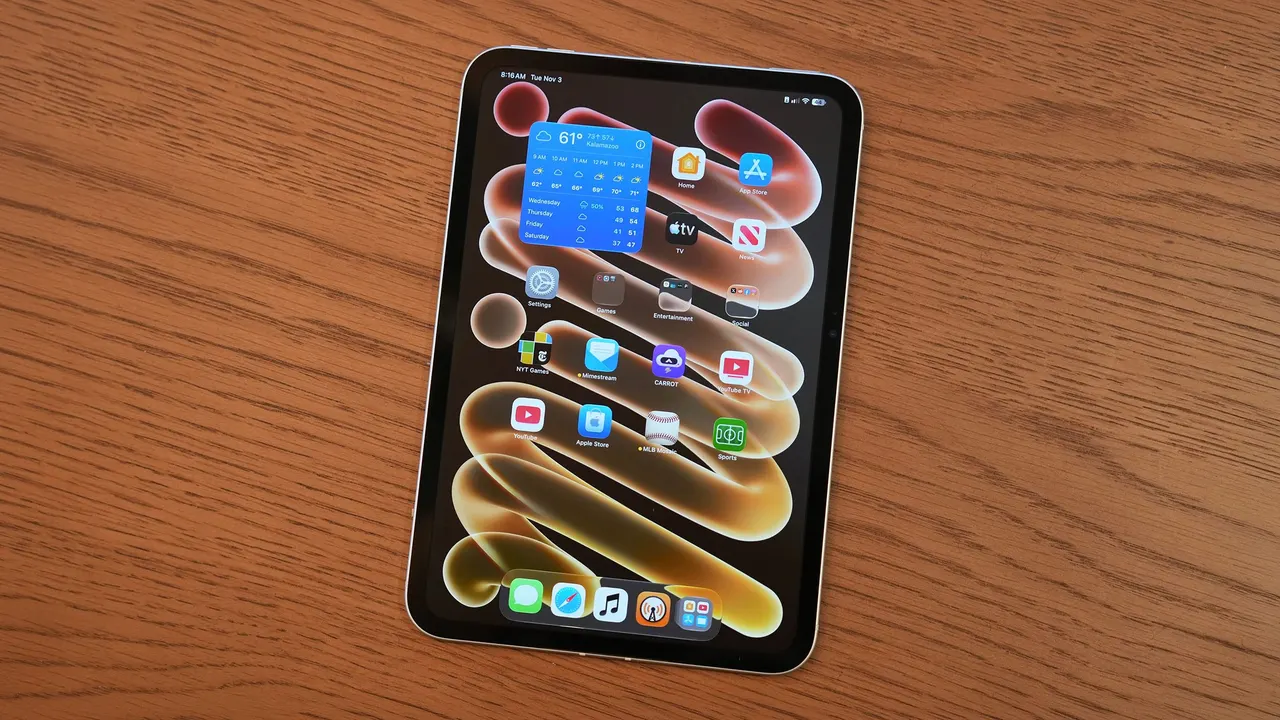
Apple’s smallest iPad has gotten its biggest update in years. The new iPad mini features a much thinner and lighter design, a larger OLED display, water resistance, and the powerful A20 Pro chip. I’ve been testing the new iPad mini, and there’s a lot to like — but also a couple of frustrations. Here’s everything you need to know. Pre-order the new iPad mini now more…
Apple’s smallest iPad has gotten its biggest update in years. The new iPad mini features a much thinner and lighter design, a larger OLED display, water resistance, and the powerful A20 Pro chip.
I’ve been testing the new iPad mini, and there’s a lot to like — but also a couple of frustrations. Here’s everything you need to know.
Design
The new iPad mini lives up to the “mini” name even more than its predecessor. It’s significantly thinner, down from 6.3mm on the previous iPad mini to 5.4mm on the new model. In fact, that puts it very close to the ultra-thin iPad Pro and the unfolded iPhone Duo. Here’s how it compares:
The new iPad mini is also significantly lighter, dropping from 293 grams to 255 grams. That puts it in the realm of the iPhone Duo, for comparison’s sake:
The reduction in weight and thickness was immediately noticeable when I picked up the new iPad mini. It feels significantly nicer to hold, more premium, and less “dense” in my hands.
The new iPad mini features an 8.5-inch screen, a slight increase from the previous generation’s 8.3-inch display. The overall footprint is mostly the same (the new model is actually about 2.2mm narrower). The larger screen is possible because the new iPad mini’s bezels are 24 percent thinner than before.
In addition to allowing a bigger screen in the same form factor, the narrower bezels also modernize the iPad mini’s overall look and feel. The bezels are noticeably slimmer than the iPad Air and base model iPad, and slightly thinner than the iPad Pro.
With smaller bezels, a thinner chassis, and a lighter weight, the new iPad mini feels significantly more premium than before. It reminds me less of the base model iPad or iPad Air and more of the iPad Pro, just shrunken down.
Display technology
The big news about the display, though, is the switch to OLED. This marks Apple’s first non-Pro iPad to offer an OLED screen. It’s not the fancy tandem OLED display of the iPad Pro, but it’s a huge improvement over the previous model’s LCD panel.
The new iPad mini offers SDR brightness up to 600 nits, up from the previous model’s 500 nits max. The iPad mini also supports HDR content, with up to 1200 nits peak brightness.
The new iPad mini’s screen is undeniably an improvement over its predecessor. All of the inherent benefits of OLED apply here, including better colors, improved contrast, higher brightness, and more.
Unfortunately, the new iPad mini’s screen has one limitation: it doesn’t support ProMotion, or a 120Hz refresh rate of any kind. Instead, it’s still locked to 60Hz. This is an incredibly frustrating decision that I can’t quite wrap my head around.
Apple touts the iPad mini’s OLED screen as offering significantly faster pixel response time than the previous generation’s LCD panel, leading to improvements like smoother scrolling and reduced motion blur.
I’ve noticed that things like swiping between Home Screen pages, scrolling social media, and system animations are noticeably smoother. They aren’t, however, as smooth as an Apple device with a ProMotion display, and they’re not a substitute for a higher refresh-rate display.
I’m sure Apple knows the iPad mini’s market, and it seems to have decided not to prioritize ProMotion based on that information. However, as someone who has longed for a so-called “iPad mini Pro” for years, I’m disappointed by the decision. The new iPad mini’s screen is so much better … I just wish Apple had gone that extra step and added ProMotion. We’ve reached a point where ProMotion should be table stakes, especially after Apple brought it to the base iPhone 17 last year.
Nano-texture
For an extra $100, you can upgrade the new iPad mini to have a nano-texture display (on the 256GB and 512GB models).
I’m a huge fan of Apple’s nano-texture display and have it on my 14-inch MacBook Pro. On the iPad mini, I think it makes even more sense.
The iPad mini is ultra-portable, and you naturally carry it around and use it in different lighting environments. The nano-texture glass helps reduce reflections and glare in a wide variety of lighting conditions. I also really like the combination of the iPad mini’s book-like size and the nano-texture finish.
There is a slight tradeoff in color vibrancy compared to a glossy OLED screen, as on other Apple devices with nano-texture, but it’s a very minor difference in my experience. The screen still looks fantastic.
Speakers and durability
One of the more interesting changes with the new iPad mini is something Apple calls the “Acoustic Display.” Instead of traditional speakers with visible grilles, Apple has developed a new system that uses the display itself to produce sound.
Essentially, Apple has designed special woofers that vibrate the display to produce low and midrange frequencies. For higher frequencies, custom tweeters are hidden between the glass and aluminum enclosure. Apple says this new system delivers louder audio, “punchier” bass, and clearer highs, despite the iPad mini’s significantly thinner design.
In practice, I think the new iPad mini sounds great. I’d choose headphones or an external speaker for serious music or video consumption, but day-to-day the iPad mini’s built-in speakers are perfectly adequate. (I’d bet that this Acoustic Display technology shows up in future iPhones too, and the iPad mini is serving as a test bed of sorts.)
The Acoustic Display also plays an important role in another major upgrade: water and dust resistance. The new iPad mini is IP67 rated, which means it can be immersed in 1 meter of freshwater for up to 30 minutes. It’s the first iPad to have an official water-resistance rating.
Adding water resistance to the iPad mini is particularly notable given its size and portability. I naturally find myself wanting to take it everywhere, and water resistance makes that more feasible.
One use case where all these improvements really come together is reading. The thinner and lighter design, nano-texture glass, and water resistance make the new iPad mini the most compelling iPad yet to serve as an e-reader.
Performance
The new iPad mini is powered by Apple’s A20 Pro chip, which I already covered in detail in my iPhone 18 Pro review. The short version: the A20 Pro chip gives you plenty of power for anything you can throw at the iPad mini today.
One detail worth calling out is that Apple uses two different versions of the A20 Pro in the iPad mini. The 128GB and 256GB models feature a five-core CPU and 16-core Neural Engine, while the 512GB model gets a six-core CPU and Dual 16-core Neural Engine. All three configurations feature the same seven-core GPU.
I don’t think anyone should buy the 512GB version of the iPad mini just for those extra cores. You should pick your iPad mini configuration based on how much storage you need, not the version of the A20 Pro chip. You don’t need to worry about performance with the new iPad mini. And perhaps most importantly, the A20 Pro chip ensures the iPad mini has enough headroom for the future.
9to5Mac’s Take
There’s been a lot of consternation about where the iPad mini fits in a world where the iPhone Duo also now exists. It’s a fair question. After all, when the iPhone Duo is unfolded, the two devices share a similar form factor … but that’s really where the similarities end.
The iPad mini offers the full-fledged, unapologetic iPadOS experience. It supports the full multitasking prowess of an iPad Pro, including windowing and the menu bar. The new iPad mini also supports extended display mode, so you can plug it into an external display and extend your iPad experience there.
The iPad mini also gets iPadOS app layouts, and most importantly, a desktop-class browsing experience in Safari. It’s a remarkably capable device in a remarkably compact form factor. It fits where other iPads can’t, yet it runs the same version of iPadOS as other iPads.
The new iPad mini does all of that, but better than before. The thinner, lighter design paired with smaller bezels gives the new iPad mini a meaningful visual refresh. The added water resistance means you can do even more with the compact and pocketable iPad mini design.
But all of this comes at a higher price of $699. This marks the second price increase for the iPad mini this year. It started the year at $499, rose to $599 as part of Apple’s broader price increases in June, and is now $699 as of this refresh.
The new iPad mini also still starts with 128GB of storage. Increasing the base storage to 256GB would’ve helped ease some of the pain of that price increase. It’s also getting increasingly hard to manage a device with 128GB, particularly with the storage needs of Apple Intelligence and Siri AI. The lack of ProMotion and Face ID also make the price increase sting more.
Ultimately, the iPad mini form factor is a joy to use. The design feels great in the hand, and having the full iPadOS experience in such a compact device remains impressive. It’s not quite the “iPad mini Pro” I’ve always wanted, but it’s big upgrade to a form factor that I’ve always loved.
My iPad mini recommendations:
Follow Chance: Threads, X, and Instagram