
Nace AI Open-Sources Drex Max v1: A 27B Decision Model That Runs Locally on Apple Silicon
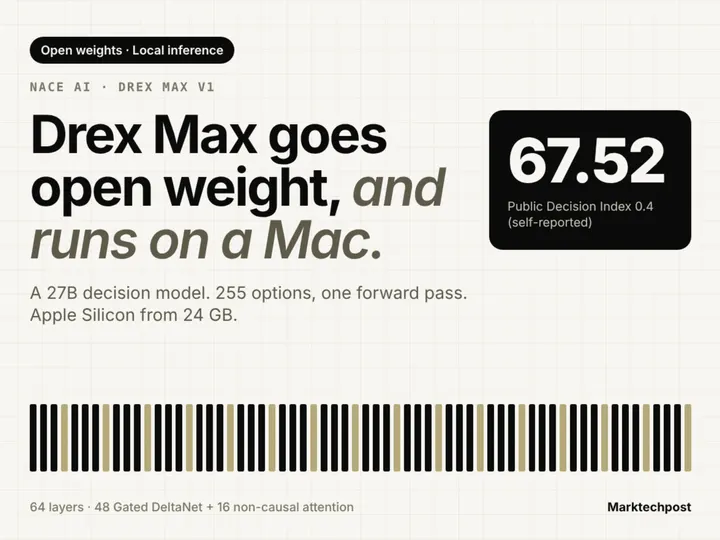
Nace AI has released Drex Max v1 as open weights . Drex Max is its most capable decision model, and it now runs on your own hardware. The release ships bf16 weights, a Q8_0 GGUF , an affine Q4 checkpoint and forks of llama.cpp and Ollama . For developers, Drex Max open weights mean routing, classification and policy checks can stay on a local machine. TL;DR Size: Dense 27B parameters, 262,144-token window (16,384 by…
Nace AI has released Drex Max v1 as open weights . Drex Max is its most capable decision model, and it now runs on your own hardware. The release ships bf16 weights, a Q8_0 GGUF , an affine Q4 checkpoint and forks of llama.cpp and Ollama . For developers, Drex Max open weights mean routing, classification and policy checks can stay on a local machine. TL;DR Size: Dense 27B parameters, 262,144-token window (16,384 by default), up to 255 options per question. Runs on: NVIDIA GPU with Python (H100 bf16, or L40S 48 GB in 8-bit). Apple Silicon Macs with 24 GB+ (affine Q4) or 48 GB (Q8_0 GGUF). CPU via llama.cpp and Ollama. Performance: 67.52 on the public Decision Index 0.4, 6.27 points ahead of Drex v2.0 (self-reported). Best: 97.3 skill on InfographicVQA. Tools area reaches 81.9. A top-tier decision model you can now run offline on a Mac. What is Drex Max? Drex Max is a decision model from Nace.AI that answers typed questions about a given context. You pass a state (text, JSON or images) plus named questions. The model returns a probability for every option in one forward pass. Nothing is generated . Questions come in 3 types: choice among named options, yes/no, and an ordinal score. That makes it a fit for agent routing, ticket triage and guardrail checks. The hosted version is presented at routing, classification and policy checks. How does Drex Max work? The model card describes a dense 27B backbone with 64 layers. 48 are Gated DeltaNet linear-attention layers that run left to right. The other 16 are full-attention layers, placed every fourth layer, and they are non-causal. Every token can attend to the whole sequence. Images pass through a native vision tower and are visible to every question in a request. A 255-way readout head then turns the last hidden state into option probabilities. The config lists a qwen3_5 model type with a 262,144-position window. &&& How does Drex Max perform on benchmarks? All figures below are self-reported by Nace AI, Decision Index 0.4 (public text): 67.52. Drex v2.0 scores 61.25 and Jev 1.13.0 scores 57.96. Area skill: Tools 81.9, Language 72.2, Retrieval 68.8, Knowledge and Reasoning 57.1, Arts 53.4. Public vision index: 73.92 across 11 benchmarks and 12,210 rows. Artificial Analysis Decision Index: 64, which Nace says ranks 4th of 18. JevBench: 92.2% (213/231). Decision Bench v4: 94.30% (1010/1071). The results dataset covers 140,620 requests. Unanswered requests count as wrong. How do you run Drex Max locally? Nace documents 5 runtimes. All of them serve the same POST /v1/systemone API. Runtime Hardware Checkpoint Images Python NVIDIA GPU bf16 (~49 GB) or 8-bit (~26 GB) Yes llama.cpp fork Apple Metal, CPU Q8_0 GGUF (27.25 GB) No Ollama fork Apple Metal, CPU Q8_0 GGUF No Kapitsa v0.2.25+ Apple Silicon Q8_0 GGUF or affine Q4 No MLX Apple Silicon affine Q4 (14.45 GB) No The affine Q4 checkpoint targets Macs with 24 GB or more. The Q8_0 GGUF needs 48 GB. On a 48 GB Mac, Nace recommends –context 2048 for Kapitsa. Ollama users set num_gpu 40 to offload 40 layers to Metal. Setting num_gpu 0 runs it on the CPU. The Ollama fork needs a CAPABILITY decision line in the Modelfile. Quantization holds up in Nace’s tests. On a 48 GB Apple M5 Pro, the Q8_0 GGUF matched H100 bf16 within 0.02 per probability. The affine Q4 stayed within 0.0329 of Q8_0, with no choice flips. Drex Max vs other decision models Drex Max v1 Drex v2.0 Drex v1.5 Jev 1.13.0 Parameters 27B dense 35B MoE, ~3B active 9B Not published Max context 262,144 131,072 131,072 Not disclosed Inputs Text, JSON, images Text (vision tower dropped) Text Not disclosed Weights Open, Nace.AI Open RAIL-M Open, Nace.AI Open RAIL-M Open, Nace.AI Open RAIL-M Closed, hosted Smallest local file Affine Q4, 24 GB+ Mac Q8_0, 36.9 GB Q8_0, ~9.5 GB Not applicable Public Decision Index 67.52 (v0.4) 61.25 (v0.3.1) 58.08 (v0.3.1) 57.96 JevBench 92.2% 85.7% Not disclosed 86.6% AA Decision Index 64 58 Not listed 58 Hosted price $0.03 / 1K decisions (launch) $0.06 / 1K decisions $0.04 / 1K decisions $42 / 1M tasks Nace AI team states that Decision Index 0.4 uses the same public suite as 0.3.1. Key Takeaways Drex Max v1 weights are now public under Nace.AI Open RAIL-M. It scores 67.52 on Decision Index 0.4, above Drex v2.0 (61.25). A 4-bit build runs on 24 GB Apple Silicon Macs via Kapitsa or MLX. Q8_0 on an M5 Pro matched H100 bf16 within 0.02. Local Mac and CPU paths are text only for now. Check out the model weights , Q8_0 GGUF , code and docs , Tweet and cloud console . Thanks to the Nace AI team for the thought leadership / resources for this article. This article is sponsored by Nace AI.