
Man unexpectedly recovers from a knife wound through his eye and brain
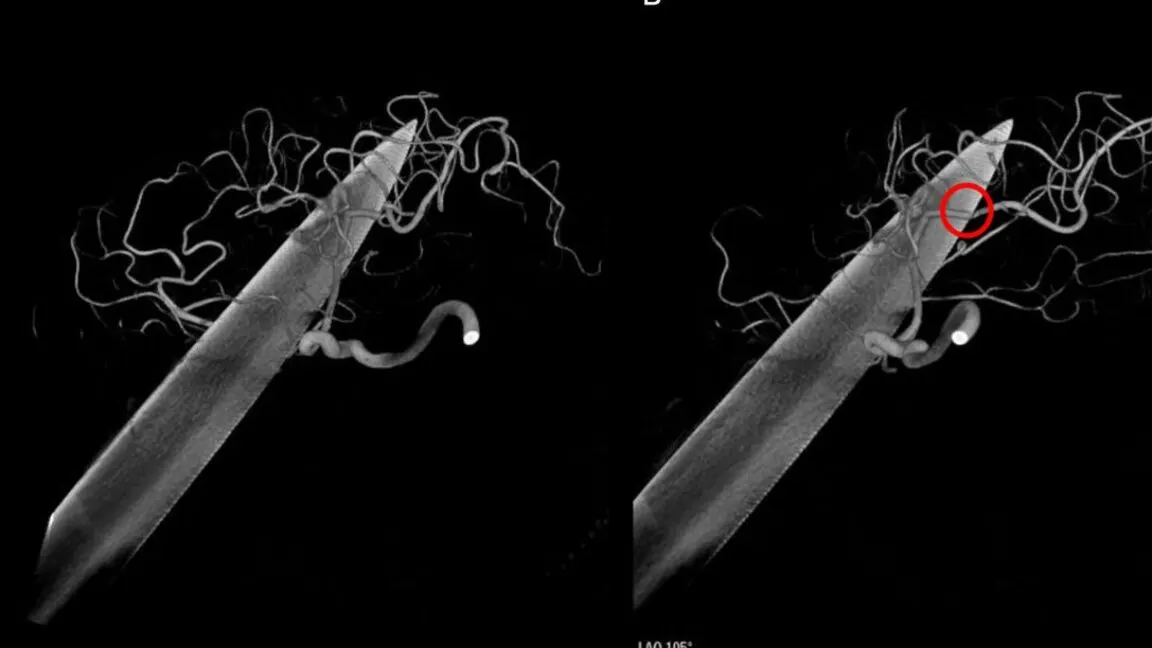
A man in his 20s showed up to a UK hospital with the hilt of a knife sticking out of his face. The 15 mm blade hidden within went completely through his right eye and through his brain, with the tip of the blade hitting the top of his skull. Despite the ghastly injury, the man was alive and conscious when he arrived. He could still talk and move all four limbs. His doctors described him as being in a state of…
A man in his 20s showed up to a UK hospital with the hilt of a knife sticking out of his face. The 15 mm-wide blade hidden within went completely through his right eye and through his brain, with the tip of the blade hitting the top of his skull.
Despite the ghastly injury, the man was alive and conscious when he arrived. He could still talk and move all four limbs. His doctors described him as being in a state of agitation. On the Glasgow Coma Scale, he scored a 12 (E3 V4 M5), indicating a “moderate” brain injury, just one point above “mild.” He could open his left eye when told, but otherwise kept it closed (E3 score); he could talk and answer questions, but was confused (V4); and he intentionally moved away when pressure was applied to his body (M5).
In a report published Friday in BMJ Case Report, his doctors said they were concerned that in his confused, agitated state he may try to pull the knife out on his own. So, they swiftly sedated and intubated him. They put him on prophylactic treatments for bacterial infections, including tetanus. Then they used images to see what was going on in his head.
“Pull-and-see”
The blade was entirely through the right eye socket and eyeball. It traversed the left frontal and temporal lobes of his brain, passing through in front of—and without apparently injuring—the corpus callosum, which connects the two sides of the brain and is full of nerve fibers. The blade also missed the left internal capsule, which holds another bundle of nerve fibers.
In terms of damage to major blood vessels, doctors found that the blade was close to the left internal carotid artery, a major blood vessel, but didn’t seem to have damaged it. Doctors did find, however, that a branch of the middle cerebral artery looked to be indented by the knife.
After consulting with various medical specialties, the man’s doctors moved to emergency neurosurgery. They opted to remove part of his skull to directly see into the brain, but used a conservative “pull-and-see” method to slide the blade out rather than invasively excavate it. After it was out, the doctors saw no signs of significant hemorrhaging. The brain wound was cleaned and drained before surgeons patched up his skull. His right eye, however, couldn’t be saved. Given its extensive damage, it was removed.