
id Software’s Marty Stratton Downplays Studio Layoff Concerns: “We’re Doing Great, and We Are Really Bullish About What We Have Ahead”
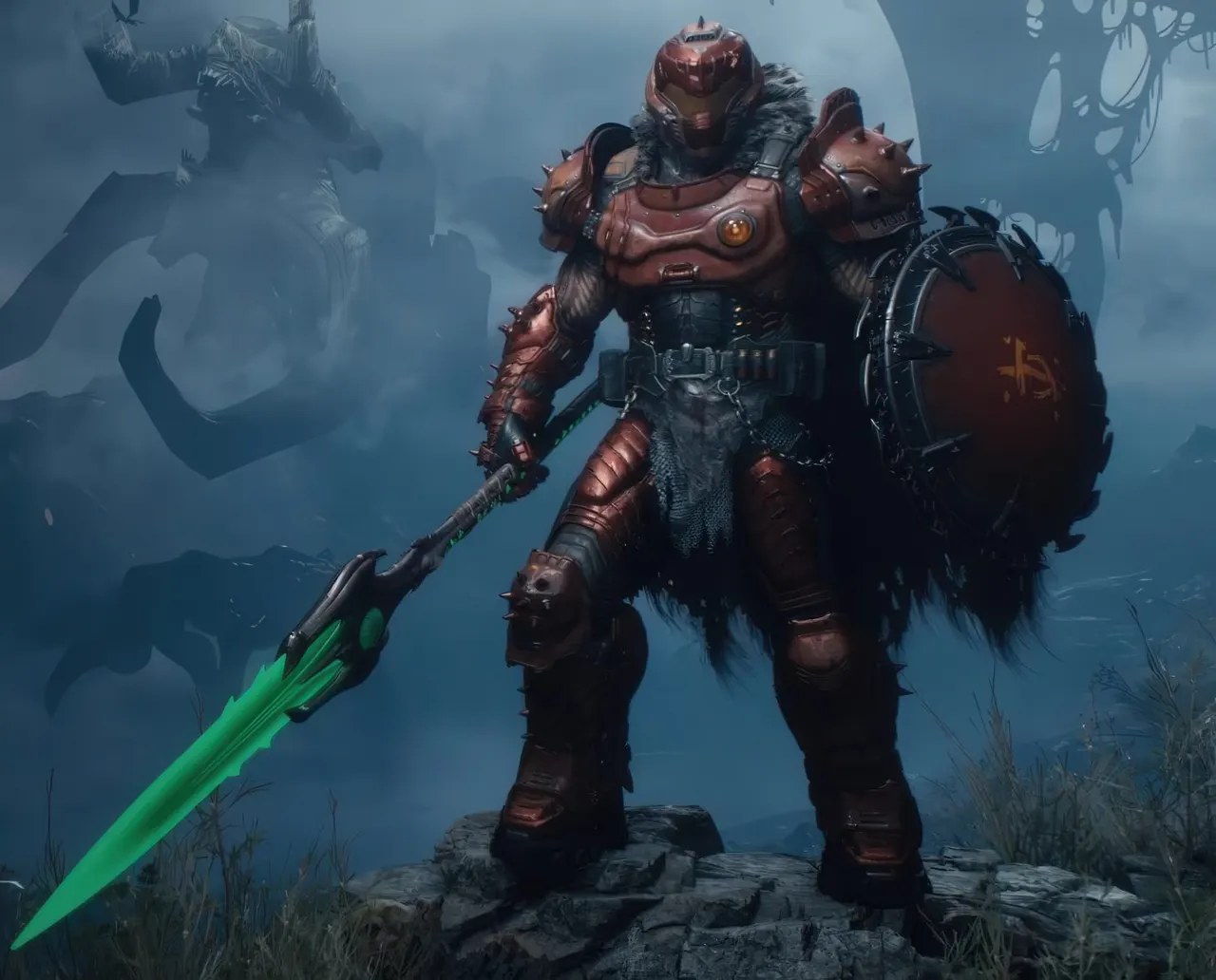
id Software's Hugo Martin (Game Director) and Marty Stratton (Executive Producer) recently hosted a media presentation walking the assembled press through the development of DOOM: The Dark Ages – Revelations, the studio's expansive DLC for last year's entry in the shooter series, before unveiling Slaughter Mode, a brand-new (and free) horde-like mode. They also took questions from us attending journalists, including…
id Software's Hugo Martin (Game Director) and Marty Stratton (Executive Producer) recently hosted a media presentation walking the assembled press through the development of DOOM: The Dark Ages – Revelations, the studio's expansive DLC for last year's entry in the shooter series, before unveiling Slaughter Mode, a brand-new (and free) horde-like mode. They also took questions from us attending journalists, including a more in-depth response about the concerns that followed id Software's substantial layoffs mandated by Xbox.
Martin opened by describing Revelations as the product of the smoothest development cycle the team has experienced, crediting that to the accumulated experience of roughly three mainline games and two DLCs. Interestingly, the team finished early, which left them with an unusual amount of runway for iteration and polish and allowed the team to pack the DLC with secrets. Martin noted that to date, players still haven't unlocked everything in the expansion.
"Don't do more, do better"
The design philosophy driving Revelations was to focus on one deep tool rather than spread effort across multiple new weapons and equipment. That tool is, as people who already played the DLC might easily guess, the Chain Spear, built to fundamentally change how The Dark Ages plays while still leaving the shield as a viable alternative. Martin said it takes time to master the new weapon, but it’s worth it as it increases the number of decisions available on the battlefield and dramatically raises the ceiling for skill expression.
The spear adds new movement options to the combat of DOOM: The Dark Ages, including a dash and a grapple hook. Martin and Stratton characterized the resulting feel as putting a jetpack on a tank: mobile like Eternal, but heavy like Dark Ages. The spear's abilities each carry their own upgrade trees, covering stabs, downward slams reminiscent of Eternal's hammer, thrown sniper-style attacks, an orbit mechanic for circling enemies while firing, and the slash, which can break armor, kill fodder for resources, or parry incoming melee and projectile attacks.
Levels and the Metroidvania Turn
Revelations marked the first time id has meaningfully expanded Metroidvania elements in a modern Doom game, with more backtracking than the studio has ever attempted. Martin said the level designers consider it their best work, and that coordinating it from a memory and technical standpoint was genuinely difficult.
The campaign splits into two distinct layers, viewable as separate overlays on the auto-map: roughly 60% base game missions and 40% endgame content. The Endgame content unlocks after completing the base campaign and includes master-level difficulty challenges, unique original paths through existing levels, Greater Suit encounters, Slayer Trials (arcade-style scored levels), new endgame resources and upgrades, and unlockable playable spaces from classic Doom games. Completing it all grants the Astral Key, which opens access to the Uber Boss; defeating him unlocks the Master Arena Key and four intensely difficult combat arenas. Clearing those unlocks further content in the Repertorium, including the fully upgraded spear, new maps, and encounter presets.
New enemies include the returning Archvile and Pain Elemental, an all-new Wizard that buffs allies and evades attacks, and upgraded AI variants including the Spectre Whiplash, purple Hell Knights, and explosive zombies that create environmental hazards.
Story, Scale, and Sound
Martin claimed Revelations let the team pay off lore threads they'd been discussing for 13 years, including finally delivering the Wretch, a character referenced in a Doom 2016 codex entry as the maker of the Slayer's armor. He called the armor-forging sequence one of the best cutscenes id has ever made, and summarized the team's narrative approach as "feel it, don't watch it."
Both developers repeatedly stressed that Revelations far exceeds the scope of the average DOOM DLC. It runs roughly 10 to 12 hours depending on difficulty, equal to both Doom Eternal DLCs combined, with a year of polish behind it. Stratton noted that it's nearly as large as the base game in terms of time, and Martin admitted it could have shipped as a standalone sequel.
Slaughter Mode
The session's big reveal was Slaughter Mode, a new horde experience launching in November, free to anyone who owns Revelations or the Deluxe Edition of Dark Ages.
Built as a response to fans wanting more of the Revelations combat loop, Slaughter Mode spans 19 arenas drawn from the base game, the DLC, and the Repertorium. Each round throws a new randomized combination of enemies at the player, with the run's value increasing as rounds are cleared. At checkpoints, players choose between banking their rewards or risking everything for a larger payoff; failure forfeits whatever was left on the line.
Rewards include character and weapon skins, profile icons, and tracks from Andrew Hulshult's IDKFA soundtrack, with weekly challenges layered on top. Martin framed the design goal as capturing the drama and tension of Ultra-Nightmare's permadeath stakes in a form approachable to a broader audience. Players enter with a fully unlocked spear from the start.
Stratton emphasized that Slaughter Mode was built entirely in-house over the last few months, with no outsourcing whatsoever, including the in-engine cinematic trailer.
After the presentation, Martin and Stratton kindly stayed to answer many questions in a roundtable format. Keep scrolling to read the full transcript, lightly edited to remove filler words and repetitions.
The Big id Software Q&A
From the story to the gameplay, Doom has really evolved from the reboot to the Revelations DLC. Given how the story wrapped up in Dark Ages and Revelations, is this the end of the Doom Slayer's current story arc, or is there more to come?
Hugo Martin: It's marketing's favorite kind of question. I always get nervous when people ask me this stuff. One of the first questions we are asked in interviews is about the story, in a brand that is supposedly not about story. So, I love it.
There's definitely more stories to tell, but we're focused on what we're working on next, so we can't really say anything about that. But yeah, we still don't know how he gets captured in that sarcophagus. I always think of it like these are chapters from the Slayer saga. That's why we make that stuff. It gives you yet another reason to just dive back into the Doom experience, ripping and tearing. So there are certainly more stories to tell. We can't talk too much about that, but yeah.
What goes into creating backtracking in levels that is interesting instead of feeling repetitive?
Hugo Martin: It has to be new paths. If it is just literally go back into the level, maybe just do it backwards this time, or just re-traverse the same path you took but now there's new combat, that's not enough.
It's cathartic if done well. You go through the first time. A lot of games do this really well; think about the Metroidvania loop: I pass by the locked door several times, maybe there's bars and I can see that there's a resource in there that has me curious. You walk by in Hell's Core, the ice level, and you see a classic Doom 1993 pixelated door. I think that builds up a want in the player. And then by game's end, they're given the key that unlocks the door. Once inside, and they complete that awesome classic '93 mission, they experience a sense of catharsis. And then they also get an awesome reward, which is the '93 shotgun that they can unlock if they go through those spaces.
So, I think you need original paths. You have to really make it worth their time with good meaty rewards. And we think Dark Ages Revelations does a really good job with that.
Doom: The Dark Ages really blew some people away with how you swapped Eternal's frantic parkour for that iron tank feel. You can really see that in the design, soundtrack, and heavier, more grounded combat. How did you bring that into Revelations?
Hugo Martin: We put a jetpack on the Abrams tank. That's literally it. It's like, okay, what if we made the tank fly? That was the spark, right? Because you're mobile like in Eternal, but heavy like you are in Dark Ages.
Marty Stratton: Sometimes it's just as simple as those types of things. Hugo always calls them sparks. You find one of those things and you chase it, and it's surprising how impactful just something like that can be. Make the tank fly a bit.
And I would say it's interesting because the mobility, I wouldn't even say it's quite as intense as Eternal. It's kind of this hybrid. A lot of the way the spear works, in the orbiting, you're still kind of staying in this horizontal x-axis. We talked a lot in the development of Dark Ages around aiming along the x-axis. And while the spear does allow you to get kind of vertical, on the y-axis, that orbiting element and being able to shoot while you're orbiting helps keep it that heavy feeling as well.
Hugo Martin: You're giving the player more control with the orbit, so the opportunity for skill expression goes up when you give players that kind of control. And then when you come down, you feel like you weigh 1,000 pounds. Which is great.
The biggest thing about Revelations was that truly mastering and upgrading the spear happened way after completing the story. This made players want to go back and play it again from scratch, but with all the upgrades unlocked, and there was no option for that. Does Slaughter Mode come with some sort of New Game Plus mode, or is there no hope for that at this point?
Hugo Martin: Can't do a New Game Plus because of the backtracking. Maybe in the future if we were to try that again with a game from scratch. But the tech and the way it works — Marty could probably explain that a little bit more than I can. Other than, yes, it's just technically too difficult.
We've also been asked, can I bring the spear into the base campaign, because I'd really like to fight some of those encounters with the spear. Well, in Slaughter Mode you'll get the chance, because as you saw in the trailer, it pulls arenas from the base game, which are real crowd pleasers for fans of Dark Ages, as well as the DLC and some Repertorium arenas.
So we can't do a New Game Plus, but we do think that Slaughter Mode will help scratch that itch, because you're going to be able to fight in a ton of spaces with the spear that's fully loaded from the start.
Marty Stratton: Slaughter Mode really allows players to flex. It really should be fun.
If this hasn't been said by the time we get to it, are there any plans for a second major DLC? Where does Doom even go after such an ambitious DLC?
Hugo Martin: You've got to see how he gets trapped in the sarcophagus. That's not saying we're making another DLC or announcing anything, but like I answered in the first question earlier, there's definitely more stories to tell. Whether we do it or not, TBD.
And I love that the fans consistently say, how could they top that? I've heard that so many times, like, they're not going to top Eternal. And then we use that as a challenge to reinvent the combat loop. I think we did with Revelations. It's totally different while similar enough to Dark Ages. Still feels heavy, as we said, but it is a whole new combat loop and fans argue it's arguably our best. So we take that as a challenge. That's what you get up for as a developer, to see if you can do one even better.
Will Slaughter Mode be the last major content update for Doom: The Dark Ages, or will support for the game continue into 2027?
Marty Stratton: We'll have to see. I think Slaughter Mode has opportunity for additional updates. But like I said before, we're really already pretty diving deep into what's next for us. So we'll see how people respond. We're always keeping, obviously, like any good dev, our ear to the ground — what works, what people love, what they want — and kind of figuring out paths from there.
So, no to anything? It's not worth saying no to something, but it's also not necessarily a yes. We've got a lot that we want to do and we've got a lot on our plate. So we're going to just prioritize from there.
The Flynn Taggart moments were freaking sweet. Any chance we could see more of that in future Doom games? And if you can't comment, consider this a request from a fan.
Hugo Martin: We can't comment, but it would be awesome. It's so much fun. And that was so cool to be able to do that, by the way, and work on a truly grounded Slayer — where we say the Slayer's grounded in Dark Ages, but to design the Flynn Taggart version of Doom Guy, that was super fun.
Marty Stratton: I said this yesterday in a call — it just never gets old. There's just so much that we could do with Doom. It's so much fun. And you can see that. Like Hugo referenced earlier, people came away from 2016 like, "How did he get in that sarcophagus?" And, "How did he get his suit? What is this Wretch?"
Every game plants different seeds for future evolution and future expansion. So it's super rewarding when you hear somebody say, "Hey, I love this aspect, I want to see more of that." That's exactly the point, and has been from 2016 on.
How's the studio doing post-layoffs, and how does it affect what you can do next in terms of the scope of your future games?
Marty Stratton: I think we're doing great. Not to hand-wave the impacts — everybody knows that we had about half of our studio exit as part of that. But there was a very deliberate effort to make sure that we were incredibly viable coming out of that, across everything we do, across game development and technology development.
From a technology perspective, we're working more closely with MachineGames than ever. We've always had a very close partnership with them, but we're at a point with technology development where both teams are incredibly talented, have incredibly talented engineers, and we're really on an amazing path that had started pre-impacts. As part of the Xbox reset, we kicked this off earlier in the year, but it's really taken shape over the last several months. Really excited about that.
And again, the team is incredibly capable across all of our disciplines. Like I said, Horde Mode was completely built internally. That cinematic trailer was completely built internally. A lot of teams would outsource that to an agency, but we have masters of the craft here at the studio. So super proud of the team, and I think we're both really bullish on what we have ahead.
It's always hard not to be able to talk about that stuff. It's still early, but as much as anything, I don't think either of us would want to be here if we couldn't feel like we always had the opportunity to do our best work as the next thing we were going to do. So it was certainly a moment that we all had to work through. It's just one of those things that you adjust and you move on. Like I said, we really made sure that we were in a position to be fully capable moving forward, and I think we've already proven that's the case.
Hugo Martin: The studio's been through a lot of changes too. I think we believe in it because we faced a lot of challenges through the last 13 years.
Marty Stratton: I've been here 26 years. This isn't the first time we've had some ups and downs.
Hugo Martin: John Carmack left the studio. He invented our engine and the first-person shooter genre, and then his tech team went with him to Meta soon after. So that was an example of a huge change that the studio went through. It's an evolution. They're challenging, like Marty said, but we've been through them before. It changes the way we work, but we continue on, and we did after moments like that with Carmack and the tech team.
Marty Stratton: Even before 2016, we had a pretty challenging run in the years leading up to 2016, which everybody now looks back on with hindsight and it's like, oh, this was amazing. But 2013, 2014 — those were challenging years. We've talked about this publicly, but we canceled the other kind of Doom project that was in development; we had a lot of people who were passionate about that leave, and we had other challenges there.
Not to be hand-wavy about it — we are a very tight-knit team. We've never been bigger than a couple hundred people, so you know everybody well, you work hard together, you work in the trenches together. It's not like we're a 2,000-person team where you just kind of go through the motions. We're very tight-knit, so any time there's challenges, whether it's a layoff or a project shift or a pivot, you feel it. And you just get used to working through those things and staying level, and ensuring that you come out of it with the best opportunity possible ahead of you. I think that's where we're at.
What went into designing the spear so that players would want to use it versus switching to the shield they were already very familiar with from the base game?
Hugo Martin: A lot of rounds of polish. Again, we had the time to be able to test and test and test. You really need iteration cycles when you're making any feature in a game, if it's got any chance to be sticky and fun to play with and balanced. We think the spear is all those things.
So it was: get it in, test it internally, playtest it with different people, make sure that we feel like it's a tool you want to use. Then honestly trying to figure out exactly through testing and iteration how powerful it should be at the start versus how much power you unlock. What do you have to have out of the box for the spear in order for it to be a viable tool even in the first hour of you using it, when compared to the shield? Because once you get the shield back, if it's not balanced correctly, you might switch back to the shield really quick. And some people do, and that's why we give you the shield back.
But we made some adjustments to the shield's power based on testing and iteration and feedback, reducing some of that power and then saving it for the end game stuff when you get the full-powered shield back. Then kind of playing around with: should I be able to break armor right out the gate? Should I be able to slash? Should slash be an upgrade that I earn? All things like that come out of testing and iteration. Microsoft gave us the time to do it. We think that's why it feels so good. It's not rocket science. I tell everybody all the time, making great commercial art is all about iteration.
Marty Stratton: It was one of the first things stood up going into Revelations. We spent some time doing a bunch of updates over the course of last summer right after Dark Ages launched. There was some balance stuff, and Hugo was working really hard on all of that with the team. But I was looking back at some team meetings we had had for something else recently, and I think the first team meeting where we showed the stand-up of the spear was in September of last year.
So when you have that much time to put the polish on it — we always say the game will tell you what it wants and how it feels, but that requires having something in early. I think Ellie did a bunch of the work early getting that stood up. So that was really awesome, to have it in the game so early and give the animators time with it and the designers time with the functionality.
Hugo Martin: It wasn't a cut feature or anything from the base game. But we did settle, as Marty said, very early on wanting a spear in the game, because the touchstone for Dark Ages was Leonidas in the Hot Gates, the 300 fight scene. He has a Spartan sword, a shield and a spear. We always thought the Spartan sword was the shotgun. We obviously added the shield, and what was missing was the spear.
So it felt natural to experiment with giving the Slayer a spear. And who doesn't want to stick enemies to walls? We made that decision super early, as Marty said, which gave us much more time to polish.
Will Slaughter Mode use your personal loadout and unlocks, or will it be more like a rogue-like where you have to make the most out of what you have? A Doom rogue-like sounds pretty awesome now that I'm thinking about it.
Hugo Martin: You have the loadout from the beginning, so it's a fully unlocked spear.
While I like rogue-likes, I wouldn't want to ask the player to re-unlock something they already spent the whole DLC unlocking. And it does help scratch the itch of New Game Plus. It's not quite the same, where I spent the time through the whole DLC upgrading this thing, I've got it fully powered now — what else can I do? You can play Slaughter Mode. I think a rogue-like from scratch where we unlock new abilities and metas would be really interesting, but at that point it just becomes a different game.
Marty Stratton: The randomized combat is very cool, though. It's incredibly replayable because of the randomized combat, not so much the great paths.
Hugo Martin: Rather than spend time refining or revising the combat loop with new abilities to unlock, we set that aside. Okay, this is the core experience, that's already locked in place. Let's really focus on the reward structure, the balance, and as he said, the randomizer, which is not anything we've done before. We've never had randomized encounter designs in Doom. They were always handcrafted — there are still a few handcrafted encounters here — but developing the tech for a randomizer was a huge breakthrough for us.
Classic Doom is known for its killer multiplayer and co-op. Doom 2016 had a multiplayer suite; Eternal had Battlemode. Any plans for anything co-op or multiplayer in your future?
Hugo Martin: We'll defer to future conversations.
Marty Stratton: It's true, though. It was tough. We went into Dark Ages development with everybody still at home in COVID, and knowing that, we really wanted that campaign experience to be amazing — and not knowing when we were going to be able to be back in the office. The way we develop multiplayer, you really kind of have to be in the cycle of sitting down together and playing and talking and all that kind of stuff. So it was a little scary.
So we made that decision at the very beginning of Dark Ages to not have a multiplayer component, and to focus those resources on various other parts of the game and the campaign, and really blow that out. You're always making trade-offs, and there were a lot of factors that went into that decision, COVID being one of them.
But I think we miss it. It's fun to play games with other people.
Hugo Martin: Doom with friends is fun.
Marty Stratton: Doom with friends is fun. So we'll see. But it's part of the franchise, it's part of the brand, as you mentioned, and it's part of the question. I think we missed it in Dark Ages, for sure.
Thank you for your time.
Follow Wccftech on Google to get more of our news coverage in your feeds.