
How the American French Film Festival Is Bringing French Cinema to 3,000 Los Angeles High School Students With Packed Screenings of ‘In Waves’
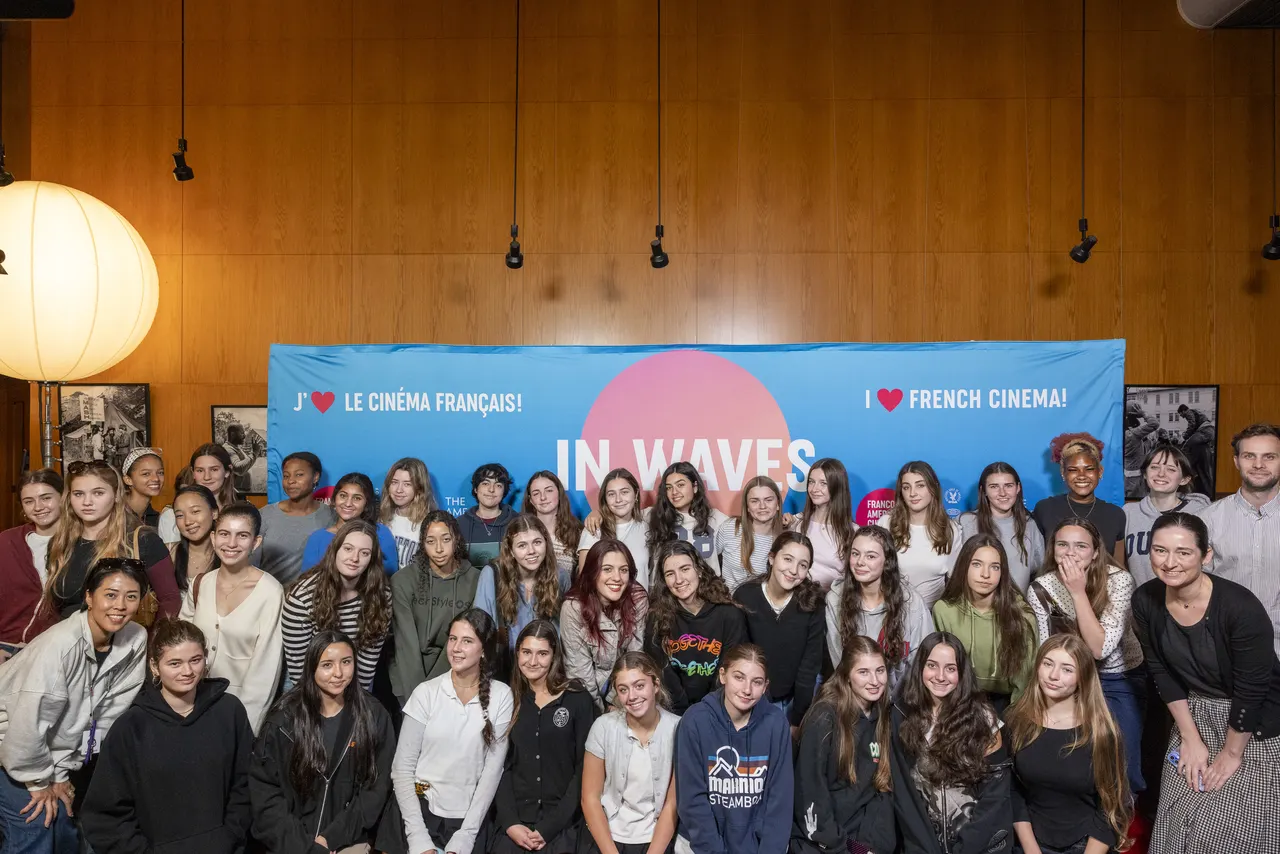
The American French Film Festival, which celebrated its 30th anniversary this year, has been on a journey to cultivate a new generation of French movie lovers for two decades with its educational program for Los Angeles high school students. This milestone edition brought around 3,000 students to the DGA theater for five packed screenings of
The American French Film Festival, which celebrated its 30th anniversary this year, has been on a journey to cultivate a new generation of French movie lovers for two decades with its educational program for Los Angeles high school students.
This milestone edition brought around 3,000 students to the DGA theater for five packed screenings of “In Waves,” Phuong Mai Nguyen’s heart-wrenching animated feature which was bought Netflix at Cannes.
Adapted from AJ Dungo’s graphic novel at set in Southern California, “In Waves” is a love story between a shy teenage boy and the girl who teaches him how to surf and how to live, before she succumbs to cancer.
The screenings, which drew applause and tears throughout, also gave students the opportunity to engage in the post-screening Q&A with the film’s producer, Priscilla Bertin, and screenwriter Fanny Burdino.
Spearheaded by Anouchka Van Riel, the festival deputy director, the program brings together more than 60 schools over five days, with roughly half coming from the public school system and half from private institutions. It also reaches beyond French-language classes to students studying performing arts and other creative disciplines.
In an interview with Variety, Van Riel discussed the importance of the programme to allow younger audiences to discover international cinema at a time when arthouse moviegoers are aging and foreign-language films face growing challenges in U.S. theaters. She also talked about the program’s rapid growth, why subtitles are no longer the barrier they once were, and the powerful response to “In Waves” which Netflix is positioning in the Awards race.
How many students and schools participate in the program?
We have more than 60 schools participating over five days, so that’s more than 12 schools a day. We organize five screenings of the same film, each with around 600 students. That’s approximately 3,000 students every year. I’ve built a database of around 300 schools, and we start reaching out in May. Within a week of sending the first email, half the seats — around 1,500 — are already booked. Then I spend the summer filling the remaining places. There’s enormous demand. We also make a point of having a mix of public and private schools, roughly 50/50. That’s very important to us. For public schools, transportation can be a challenge. Some have to apply for grants just to pay for the buses. There’s an entire economy around organizing these trips, and a lot depends on the teachers.
How does the festival work with teachers to prepare students for the screenings?
We work with the American Association of Teachers of French, which prepares two educational guides, one in French and one in English. The French-language guide is around 100 pages long. It’s incredibly detailed and allows teachers to explore the film from multiple perspectives, including its themes and cinematic language. The guides are designed to help students study the film before or after the screening. And we don’t just work with French-language classes. Around half of the participating classes are English-speaking. Many Los Angeles high schools have performing arts programs, and those students come because they’re interested in cinema and want to meet the filmmakers. The majority of these kids have never attended a film screening followed by a Q&A. That’s something we want to change.
That’s surprising in Los Angeles, where the film industry is everywhere.
It’s extraordinary. I’m a member of the Producers Guild, and I receive invitations to screenings and conversations with filmmakers almost every day. There are incredible events happening constantly, but these kids don’t have access to them. Of course, if their parents work in the industry, that’s different. But otherwise, most students aren’t exposed to that world. I grew up in a small town in Alsace, and I remember my French teacher taking us to the movies all the time when I was in middle school. Some of those screenings even had Q&As. There’s a tradition of that in France that doesn’t really exist here in the same way. We used to organize masterclasses for university students, including at USC, but we realized it was difficult to attract them. They’re already surrounded by so many opportunities on campus. With high school students, we can work directly through the teachers. That’s how we’ve developed this program.
Is the goal ultimately to cultivate a younger audience for French cinema?
Absolutely. It’s about renewing the audience. A couple of years ago, we screened “The Marching Band,” and when the film was eventually released theatrically in the U.S., I was invited to moderate a Q&A. I loved the film, so I was very happy to do it. But the theater was only half full, and I don’t think there was a single person under 65. That’s the problem. Foreign-language films have traditionally been considered niche in the U.S. Streaming platforms have helped change that perception somewhat, but we still need to familiarize younger audiences with these films. That’s why this program is so important.
Are subtitles still an obstacle for younger American audiences?
Not nearly as much as people think. We’ve conducted surveys with students after the screenings, and more than 80% say subtitles aren’t a barrier to watching foreign-language films. It’s not a completely scientific study, but it gives us a good indication of how attitudes are changing. Between streaming platforms, social media and series like “Squid Game,” young people have become accustomed to watching subtitled content. Sometimes there’s still a little hesitation before the screening. But once they’re sitting in the theater, they realize it’s easy. I really don’t think subtitles are the problem for this generation anymore. Distribution is a major part of the problem. That’s why streaming platforms have become so important for the circulation of foreign-language films. But there’s also the question of exposure. If young people aren’t given opportunities to discover these films, they’re not necessarily going to seek them out themselves.
This year’s selection was “In Waves.” What made it particularly suitable for the program?
There’s a wonderful connection between this film and the festival. The producer, Priscilla Bertin, had already come to the festival two years ago with “Wild Diamond,” and at the time she was in post-production on “In Waves.” We became familiar with the project very early, and it made complete sense for us to bring it back this year. What’s interesting is that the film is based on an American graphic novel that was discovered by a French producer in a secondhand bookstore in France and developed into a movie. We explain that background to the students before the screenings, including why it’s considered a French film and the response has been extraordinary.
The screenings were packed, and the students seemed particularly moved by the film. What was the atmosphere like?
It was very striking. At the first screening, I went straight into introducing the filmmakers for the Q&A, and I realized something wasn’t right because the students were still processing what they’d just watched. Usually, when a film ends, the students immediately line up to ask questions. But with “In Waves,” it took time. Every day, there was this moment of silence. The film had affected them so deeply that they needed a little time before they could speak. There’s something cathartic about sitting in a dark theater with other people, crying together and sharing the same emotions. You feel safe because everyone is experiencing that grief together. I think young people have fewer opportunities to experience cinema that way now. That’s what made these screenings so special.