
Dead by Daylight Studio Behaviour Built Exterminauts on a 10-Year-Old Concept: a Blue-Collar Sci-Fi Co-Op Shooter Where Players Punch In for Shifts
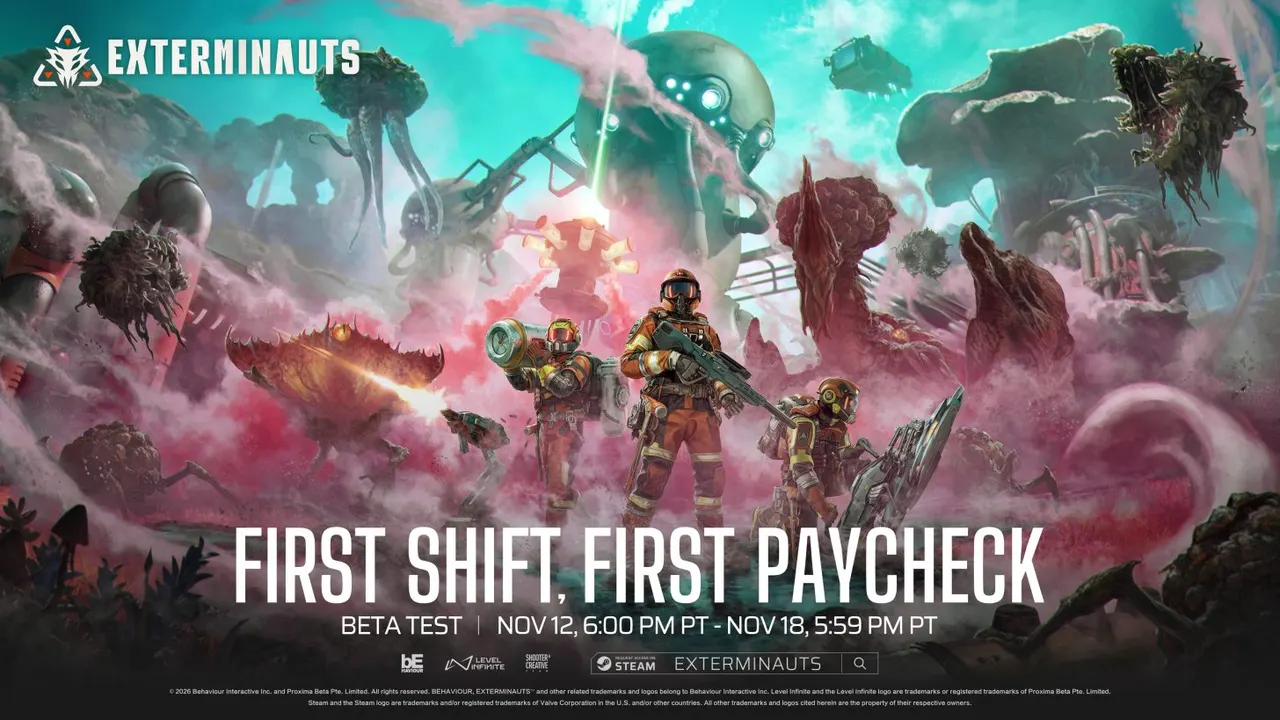
Montréal-based game developer Behaviour Interactive, largely known to the public for Dead by Daylight, is making a new game called Exterminauts. In a nutshell, it's a cooperative third-person shooter game set in a sci-fi universe where crews of three 'Exterminators' get hired by megacorporations to clear various types of alien creatures and pests. A Steam beta test of Exterminauts starts later this week, on…
Montréal-based game developer Behaviour Interactive, largely known to the public for Dead by Daylight, is making a new game called Exterminauts. In a nutshell, it's a cooperative third-person shooter game set in a sci-fi universe where crews of three 'Exterminators' get hired by megacorporations to clear various types of alien creatures and pests.
A Steam beta test of Exterminauts starts later this week, on Thursday, November 12 at 6 PM PT and runs until Wednesday, November 18 at 5:59 PM PT, with servers staying open 24 hours a day throughout the test. Anyone can request access through the game's page. Ahead of the public test, Wccftech joined a detailed media presentation and group Q&A hosted by the developers.
First of all, Exterminauts is a premium live game built around 3-player teams, with solo and duo play supported. It will launch simultaneously on PC (Steam and Epic), Xbox, and PlayStation with cross-play and cross-save, and will run seasons on a twelve-week cadence featuring battle pass content.
The game is set on the planet TIAN, which was settled by humans after the discovery of polymorphic plasma beneath its crust. In the game's lore, it's a resource that provides energy for spacefarers along with a range of useful byproduct effects. Extraction drew corporations to the planet, but it also drew the local fauna, which became increasingly aggressive in attacking infrastructure to reach the plasma.
Humans eventually abandoned the surface for space stations and moons, but the infrastructure still has to keep running, and field technicians are regularly sent down to repair and maintain it. That's the player character: part exterminator, part repairman, part first responder, or as the developers put it, the ultimate all-in-one handyman.
The team has been thinking about the concept for over ten years, drawing on blue-collar sci-fi from 1980s and 1990s films and television that featured ordinary jobs in extraordinary settings. There’s a strong emphasis on working-class heroes rather than soldiers or superheroes; in fact, you even punch in at the start of a shift and punch out at the end.
The signature piece of kit is the Overdrive, a plasma pack worn on the back with a long cable and a clamp resembling jump leads. It bypasses steps on terminals, opens doors, activates zip lines, supercharges special weapons, and can be jammed into downed heavies to detonate them. It was described as a system that the Exterminauts team expects to expand with new world interactions over time.
Five corporations provide the contracts, communicating with players over comms:
- The ITA is the Transit Authority, which brought humans to the planet and handles paperwork and procedures.
- Plasma Core extracts and distributes the plasma and is in it purely for money.
- Chem Nine wants to study it and powers most of the special weapons, which puts it at odds with Plasma Core.
- Blackburn Systems builds everything on TIAN and is the employer actually signing the player's paycheck.
- Bullet Crown is aristocratic and militaristic, fighting wars elsewhere and supplying conventional ballistic weaponry.
The gameplay loop runs from the rig, where players party up, select a work order, and tune their loadout. Objectives include clearing dried plasma tar from clogged machinery, rebooting and rerouting terminals, realigning rods, restarting pump jacks and welding, all while enemies actively try to disrupt the work, as you’d expect in a game like this. Optional side jobs along the way can increase the payout. Interestingly, punching out starts a timer - the one moment of friendly competition in the game - where teammates compete for extra points and kills toward a bonus. Loadouts carry passive and on-trigger effects across several slots, with multiple save slots so players can switch builds entirely between contracts.
Following the presentation, Creative Director Vincent Regimbald answered several questions from the assembled media. You can find the full transcript below.
The Developer Q&A
How is Exterminauts using that Gen AI technology, if at all?
Vincent Regimbald: Gen AI is not being used on Exterminauts. There’s nothing in the game that is using gen AI. In all transparency, there have been a few concept art pieces, mainly for research purposes, that were done using AI. But once we land on something and we like what we see, we always completely redo the work, and obviously have heavy human influence on the final product. So mainly for inspiration purposes, but that’s about it. Everything else that you see, all assets in the game, all voice, is all human generated.
With the idea of Exterminauts having been your mind for so long, did seeing Helldivers 2 come out and do some similar things solidify that you were on the right track, or was that a cause for concern?
Vincent Regimbald: It obviously was a fairly important moment while we were in development, because we were about halfway through, give or take, when Helldivers came out. We saw similarities. We can’t hide from that fact. One thing that it did for us was renew our confidence in the power of this genre, or the power of the co-op space in general being stronger and stronger now. I don’t know if it’s a change in patterns on some players’ part, that maybe they’re a little bit tired of playing PvP games with all the pros and cons that PvP games bring. There is an appetite for co-op games, and a pretty strong one at that.
So while it did land some concerns for us, and it did force us — or maybe inspire us — to make some changes in our concept and our design, at the same time it gave us a lot of confidence that there is a really high demand for that type of game. And while yes, there are even to this day some similarities that we cannot completely deny, we’re hoping that if you’re a Helldivers fan there’s room for another game of a similar genre that you could also appreciate, but that provides a very different type of experience, mainly with the loadouts and the types of enemies that you encounter. We feel that we’re offering something that’s quite different. Even visually, it’s really not the same type of visual signature either.
Can you explain the reasoning behind opting for three-player teams rather than the more traditional four-player approach?
Vincent Regimbald: That’s a very good question. Simply put, the reasoning behind it was that we prefer an odd number of players to an even one. If you look at a lot of sports games, they often have five players, eleven players. We drew from that a little bit when we were thinking about our player count.
The simple explanation would be that in any given scenario you could envision splitting up as a team and saying, okay, two players go that way, two players go that way, and we split the party up. That’s fairly even. You go three players, that decision becomes a little bit more — you have to think twice before splitting up, because obviously you end up having a lone wolf and two others who can tag together. Creating those odd-number situations makes the team think twice before splitting up. It’s just another way of tackling co-op in our minds. It’s a decision that we took fairly early on in development and we never looked back. We just kept it at three.
It sounded a bit as though we won’t be doing shooter-style tasks in Exterminauts. Are there any side objectives, and if so, what can we expect?
Vincent Regimbald: The side objectives for the most part are repair jobs and some light rescue operations as well. Usually and typically you’ll arrive at a site that has some damaged infrastructure. That can involve clearing out clumps of tar — I didn’t really mention that, but there’s a byproduct that comes from that plasma. It dries up and becomes a tar-like material that often clogs up different machinery, so you need to clear that out.
There are some terminal interactions where you need to reroute or reboot systems, realign rods. You might need to turn back on grab jacks, like big pump jacks. There’s welding involved as well. There’s a lot of different things that you’ll be doing to bring things back online, but in the meantime you’ll always have enemies that are in your way and trying to disrupt your operations.
You mentioned some strong similarities with Helldivers 2. Could you elaborate on what you have in mind apart from the aliens and the three-player team?
Vincent Regimbald: The other thing, as I mentioned briefly in the presentation, is the builds aspect that we’re offering and the loadouts that we’re offering. We’re giving players a lot more moving parts when they’re creating their builds. There are several slots in your loadout that have passive effects or on-trigger effects, so that you can proc certain effects on your weapons and on your character. Depending on what you do, you might have different effects that come in.
You can also create something that starts to look more like a class, or really like a stronger class identity, that has a lot of synergies within the passive abilities you’ve selected along with the weapons you’ve selected. There is more depth in our game than in Helldivers when it comes to build creation, and in all of the depth that that provides. There’s a lot more stuff to unlock, more stuff to level up in order to create those builds.
We conveniently have several save slots for different loadouts that you can create, so you don’t have to just focus on one build. You can focus on multiple at once. Depending on the contract you’re going to be taking on, you can easily switch with a click of a button to another loadout and then have a completely different play style with that loadout. That’s one of the big areas where we differ from Helldivers when it comes to our loadouts and the depth that we offer there.
Could you talk a little about what content is planned past the game’s launch, and how far that post-release content goes?
Vincent Regimbald: Past the game’s launch, we will be releasing seasons over a twelve-week period. Every twelve weeks there’s going to be a new season that comes out, and in the middle of each season we’re going to be adding more content. Our equivalent to the war bonds, or the shop in Arc Raiders, basically offers pages worth of content — extra emotes, extra weapons, extra passive abilities. That’s all coming in through our seasons.
On top of that, we’ll be adding new features, new content, new maps. Not every single season will introduce these things, because it’s a lot of work for us to actually get done, but we’ll be sure that the main beats of the game are tackled and that the entirety of the game gets increased and improved over time.
We were talking earlier about the types of repair actions that you’ll be doing in the game — interacting with terminals, bypassing systems, welding. We plan on adding more of those repair actions in the future. I won’t mention which ones we’re planning on working on, but if you think of the variety of things that blue-collar workers might do that work with their hands, the types of actions they might perform on a worksite — for us, what’s interesting is that Exterminauts opens up a really big array of things that you can imagine. I don’t want to name any type of job or any type of first responder action that you might do, but we see this as a very rich pool of activities and actions that we can now provide players, and that will typically happen over our live releases.
How many people within Behaviour are working on Exterminauts, and for context, how does that compare to Dead by Daylight? Outside of Behaviour, how many more folks are working on it?
Vincent Regimbald: For the Behaviour part on Exterminauts, it’s a team of over 150, and we’ve maintained that number for several years now. The team has been at peak numbers for a few years.
Externally, we have our partners who are working as publishers. We’re in constant contact with them. They do offer feedback and some deeper analysis on our game at times, so we are in deep collaboration with them to align on the product, on the game and on the experience. But for the most part, everything is done internally at Behaviour. Everything, especially on the front end side, everything that’s client facing, is all done at Behaviour. We’re also working a little bit with our partners on the back end side of things, so there is some communication with them on that as well. But for the most part, front end is all Behaviour.
As for how that compares to Dead by Daylight, I don’t necessarily want to advance an answer on that too quickly, because I’m not part of DBD. Behaviour is a fairly big company. We’re over 1,400 in Montreal and worldwide, and there is obviously a very big team working on DBD right now. Given the fact that it’s a live game and they have a lot of different services at play to maintain and sustain that game, they are a very large number. They are more than what we currently represent in terms of team size — I’ll say that at least. If I could clarify as well, there is no crossover between the people working on DBD and the people working on Exterminauts. We’re the same company but two distinct teams.
What did you learn within Behaviour that you were able to put to work with Exterminauts?
Vincent Regimbald: That is a very good question. As I just mentioned, we are not the same team, so I’ll say this: Exterminauts is certainly the most ambitious original IP since Dead by Daylight. I don’t want to take away anything from them, because they’ve done a tremendous amount of work and they are incredibly respected in the industry. They are a very solid pillar — in fact, probably the central pillar — to Behaviour. But since then, Behaviour has been busy on a whole bunch of different projects. We do a lot of co-development and smaller developments, but since then, Exterminauts is certainly the biggest IP that we’ve worked on.
In terms of learning, one thing that DBD did bring to Behaviour is a lot of seniority, a lot of knowledge about the industry, a lot of really strong talent joining our ranks over the years. When we started to put the team together for Exterminauts, there was a mix of assembling people from within the company, veterans — some of them have worked on DBD before, yes — but we also brought in a lot of external talent to Behaviour to start working on Exterminauts. Adding more individuals who have worked on shooters before, on larger PC and console games, who have experience with shipping large titles. These are the types of people that we brought on board to take on this ambitious project.
Thank you for your time.
Follow Wccftech on Google to get more of our news coverage in your feeds.
Comments
Comments appear after moderation. Persian and English conversations are separate.