
A deep dive into Thomas Massie’s articles of impeachment against Pete Hegseth
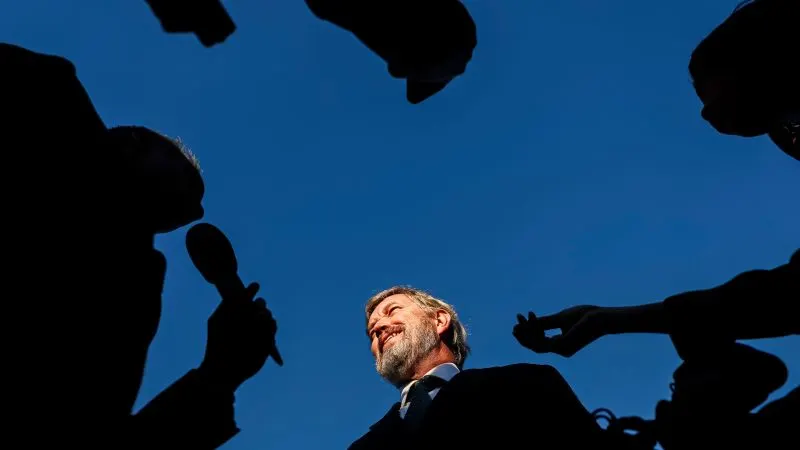
Congress may be moving toward voting on Defense Secretary Pete Hegseth’s impeachment.
But for what, exactly? That’s still the subject of some debate. Hegseth’s critics have offered a veritable grab bag of reasons.
GOP Rep. Thomas Massie of Kentucky has outlined eight impeachment articles that are set to be voted on in the House by Wednesday. But Democrats have focused on a narrower set of alleged offenses — some of which aren’t even included in Massie’s eight articles.
While the Iran war is the big, broadly unpopular item that Hegseth’s critics appear most focused on, other articles about the Trump administration’s boat strikes on alleged drug traffickers and a strike on an Iranian elementary school are arguably closer to the mark when it comes to impeachable actions. Massie indicated Tuesday that if these articles fail as a bloc, he’ll force a vote on each individual article.
So what alleged offenses has Massie laid out? And how compelling is the evidence of impeachable conduct?
Let’s break down the big ones.
The Iran war
Expected Democratic House Speaker Hakeem Jeffries said this weekend that he supported impeachment because Hegseth had “abused his power, undermined our national security, and engineered this reckless and costly war of choice in Iran.” But failed wars aren’t traditionally treated as “high crimes and misdemeanors,” which is the constitutional standard for impeachment.
Massie’s articles are largely focused on the idea that the war is also illegal; three of his eight articles are about Hegseth allegedly violating the 1973 War Powers Resolution by a) launching the war without congressional authorization, b) continuing the war even after both chambers of Congress voted to instruct President Donald Trump to end it, and c) continuing the war after the 60-day clock on unauthorized wars expired.
But one problem with impeaching over this is that other presidents have also flouted the War Powers Resolution with overseas strikes. And if these are impeachable offenses, why isn’t Congress impeaching the commander-in-chief who actually launched and continued the war?
The Iranian elementary school strike
While a narrower focus, this was one of the ugliest episodes of the early part of the war.
At least 156 people, including 120 children and 26 teachers, were killed on February 28 when a school in the southern city of Minab was struck, according to Iranian officials. While estimates vary, that would make it one of the worst civilian casualty incidents in recent US military history.
The Trump administration has resisted taking accountability for the strike, regularly citing an ongoing investigation.
The US military intended to strike a neighboring Islamic Revolutionary Guard Corps naval base but accidentally struck the school due to outdated intelligence, CNN has reported. A United Nations report in September concluded that two deadly strikes early in the war, including the one on the school, might have been a war crimes.
The strike on the school would seem to be a fruitful target for impeachment, given the evidence that warning signs were bypassed and the fact that it’s damaged US credibility.
But a valid question has to be: Why impeach just Hegseth? Why not target the commanders who approved the strike and, potentially, those who carried it out? There is also plenty that’s not yet known about the episode, making impeachment over it a potentially fraught pursuit.
The boat strikes
Speaking of potential war crimes, the administration’s targeting of boats in international waters, which it says is about curtailing the flow of drugs to the United States, has long been criticized as such.
The administration has killed at least 243 people on at least 80 vessels since September 2025, according to CNN’s running tally.
The issue here is that these killings have involved no legal due process or public accounting for whether the people targeted are actually drug traffickers. Critics have labeled them “extrajudicial” killings and even murders.
The administration has justified the strikes by saying it is in “armed conflict” with drug cartels and that the people on the boats are “unlawful combatants.” But Democratic Sen. Tim Kaine of Virginia has said his careful review found the strikes have likely illegally killed “individuals who are not involved in narcotrafficking.”
And even many Republicans have raised concerns about an early episode in which the military launched a second “double-tap” strike that killed survivors on an alleged drug vessel.
Much remains unknown about these strikes, and the earlier question applies here too: Why focus on Hegseth and not other military officials? But when it comes to the boat strikes at least, there is a deliberate action that pushes the bounds — and has caused concern even on the right.
Infringing on Mark Kelly’s free speech
Another highly problematic episode was the Trump administration’s targeting of six Democratic lawmakers who cut a video urging US service members and intelligence officials not to obey unlawful orders.
The lawmakers were largely restating guidance that members of the military are already given. But the administration cast their video as undermining Trump in his role as commander-in-chief — and even as sedition. In a remarkable and shocking escalation, the Justice Department tried and failed to indict the six Democrats.
Massie zeroes in on Hegseth also trying to punish one of them, Democratic Sen. Mark Kelly of Arizona, by cutting his retirement pay as a retired Navy captain. A Republican-nominated federal judge later ruled that this amounted to unlawful retaliation against Kelly for exercising constitutionally protected free-speech rights.
This episode might seem a little small bore, given it involved retirement pay and not a deadly military conflict.
But it’s the one article of impeachment that’s arguably most focused on Hegseth and Hegseth alone. And there’s precedent for arguing it was an abuse of power, because that’s basically what the GOP-nominated judge said in his scathing ruling.
There’s also the case to be made, as Massie does, that Hegseth’s actions violated the separation of powers by trying to intimidate a member of the legislative branch.
‘Kidnapping’ Maduro
When the Trump administration invaded Venezuela and arrested its leader to stand trial in the United States, it initially said it was about law enforcement and it wasn’t a war.
But since then, Trump has increasingly pointed to other goals — even rather imperialistic ones, like taking Venezuela’s oil — and cast the operation as a successful war.
Massie’s impeachment article on this episode accuses Hegseth of directing the Pentagon to carry out an “act of war against a sovereign country executed under the guise of narcotics law enforcement.”
Given the administration’s conflicting signals about the purpose of this mission, it’s logical to cast it as having been carried out under false pretenses. The administration has also repeatedly appeared to be stretching its authorities.
But Democrats aren’t focusing too much on this unorthodox episode — perhaps in part because ousted Venezuelan leader Nicolás Maduro engenders almost no sympathy among the US public and the mission didn’t appear terribly unpopular in the weeks after it was conducted.
The Yemen strikes
This article — in which Massie accuses Hegseth of again violating the War Powers Resolution by launching strikes in Yemen in 2025 — may be the least talked about
Massie says the administration’s group chat messages that were released as part of the “Signalgate” episode showed that Yemen’s Houthi rebels did not pose an imminent threat. At one point in the chat, Hegseth acknowledged that “we can easily pause” the strikes.
There could be something problematic for the administration in here — especially given contemporaneous comments from high-ranking officials bolstering Massie’s allegation that there was no imminent threat.
But even more so than the Iran ones, this article raises questions about why Congress would impeach over these strikes conducted without congressional authorization but not others from previous administrations.
Also interestingly: There is no article of impeachment specifically focused on Signalgate. This despite an inspector general report last year finding that Hegseth had risked compromising sensitive military information that could have endangered US troops.
Comments
Comments appear after moderation. Persian and English conversations are separate.